


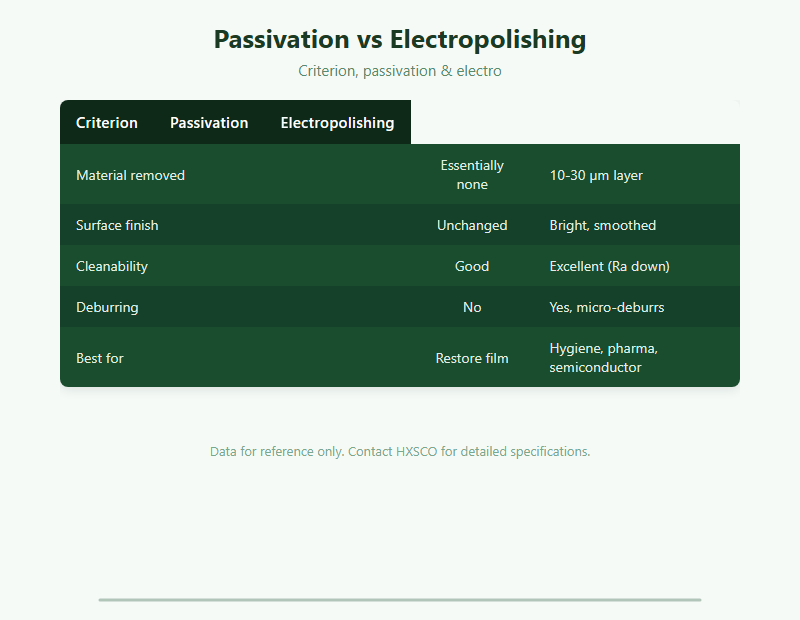
Short answer: Electropolishing is an electrochemical finishing process that dissolves a thin, controlled layer of stainless steel to leave a smooth, bright, micro-deburred surface with maximum chromium at the surface; unlike passivation it both cleans and reshapes the surface, making it the preferred finish for hygienic, pharmaceutical, food and semiconductor duty.
At a Glance
What Electropolishing Actually Does
In an electrolytic bath the part is the anode and a controlled current preferentially dissolves the high points of the surface, smoothing peaks and valleys while enriching the top layer in chromium and nickel. The result is a brighter, lower-roughness finish with fewer crevices for bacteria or contaminants to lodge — a different job from Passivation Vs Pickling, which only removes free iron and lets the film reform without changing geometry. The visual and tactile result sits alongside the other finishes in Stainless Steel Surface Finishes, and the cleaning discipline that follows it is in How To Clean Stainless Steel.
Where It Is Specified
Electropolishing is mandated or strongly preferred wherever surface cleanliness and cleanability are critical: pharmaceutical and biotech process equipment, food and dairy lines, semiconductor gas lines, and medical instruments. It also improves corrosion resistance in tight-tolerance parts because it removes embedded iron and micro-burrs that would otherwise nucleate attack — relevant to the grade guidance in Uitleg over roestvast staal and especially beneficial on Duplex Stainless Steel Guide en Stainless Steel 316 Properties components. Passivation alone is usually enough for general industrial parts; electropolishing is the upgrade for hygienic and high-purity service.
Process and Quality Checks
The part is cleaned, racked, immersed in the electrolyte (typically phosphoric-sulphuric acid) and processed at a controlled current density and temperature, then rinsed and passivated. Acceptance is verified by a water-break test, a copper-sulfate free-iron test and Roughness (Ra) measurement. It is one option within the broader Metal Surface Treatment Guide, and the material certificate for the base stock is confirmed per Mill Test Certificate Guide. HXSCO supplies electropolished tube, fittings and fabricated assemblies, or arranges the finish on parts machined through our Cnc Machining Supplier programme.
Get a Quote
Tell HXSCO your requirements and we will respond with a competitive quote and lead time.
Veelgestelde vragen
It is an electrochemical finishing process that dissolves a thin controlled layer of metal to leave a smooth, bright, micro-deburred surface enriched in chromium — improving cleanability and corrosion resistance.
Passivation only removes free iron and lets the passive film reform without changing shape; electropolishing also removes 10-30 µm of material, smoothing and brightening the surface and micro-deburring it.
Specify it for hygienic, pharmaceutical, food, dairy, semiconductor and medical applications where surface cleanliness, low roughness and bacterial resistance are critical.
Yes. HXSCO supplies electropolished tube, fittings and fabricated assemblies, or arranges electropolishing on machined parts, with roughness and free-iron verification.
Get Electropolished Stainless from HXSCO
HXSCO supplies electropolished stainless steel tube, fittings and assemblies for hygienic and semiconductor duty, with roughness and free-iron verification. Send your spec for a quote.