


Short answer: Welding consumables — stick electrodes, MIG/TIG wire and flux-cored wire — must match the base metal and process: 7018 or ER70S-6 for carbon steel, ER308/ER316 for stainless, 4043/5356 for aluminum; choosing right avoids cracks, porosity and weak welds.
At a Glance
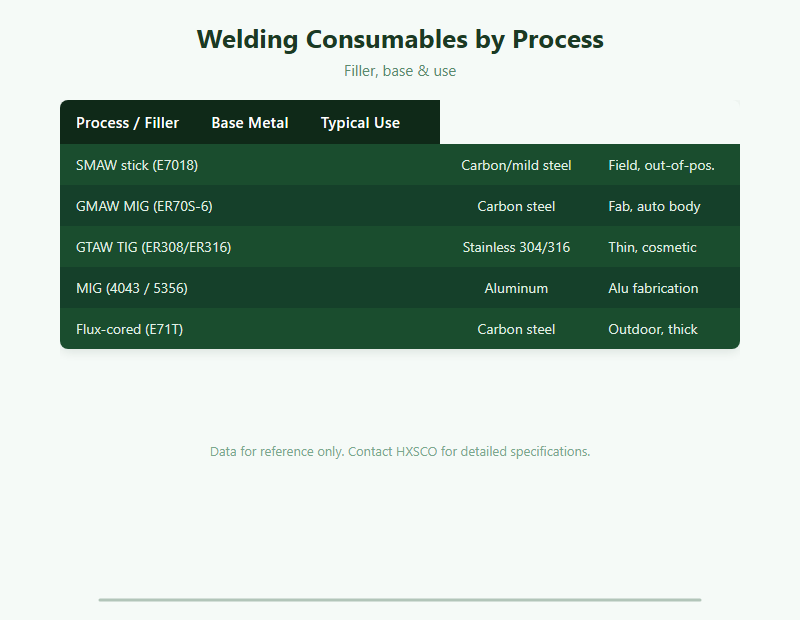
Electrode & Wire Types
The consumable carries the filler metal and shielding. Stick (SMAW) uses coated electrodes like E7018; MIG (GMAW) feeds ER70S-6 wire; TIG (GTAW) uses a matching rod. Process choice follows How To Weld Stainless Steel, How To Weld Carbon Steel and how-to-weld-aluminum.
Choosing Filler by Base Metal
Match the filler to the base: ER308L for 304 and ER316L for 316 stainless (see Stainless Steel Supplier); 4043/5356 for aluminum (see Aluminum Supplier); copper alloys use silicon- or tin-bronze wire (see Copper Supplier). Wrong filler causes cracking or poor corrosion resistance.
Storage & Quality
Keep electrodes dry (low-hydrogen rods in a rod oven) and verify chemistry from the mill certificate (see Mill Test Certificate Guide). Surface prep and cleaning are in Metal Surface Treatment Guide; corrosion planning in Galvanic Corrosion Guide.
Get a Quote
Tell HXSCO your requirements and we will respond with a competitive quote and lead time.
Pertanyaan yang Sering Diajukan
Use E7018 low-hydrogen stick electrodes or ER70S-6 MIG wire for carbon and mild steel — strong, low-crack deposits.
Use ER308L for 304 and ER316L for 316 stainless; for TIG use the matching-grade rod to keep corrosion resistance.
Use 4043 for general aluminum welds and 5356 for higher strength and better anodizing colour match.
HXSCO supplies weldable carbon, stainless and aluminum with mill certificates; we advise on matching consumables per your spec.
Weld with HXSCO Stock
HXSCO supplies weldable carbon, stainless and aluminum with mill certificates and advises on matching consumables. Send your alloy and quantity for a quote.