


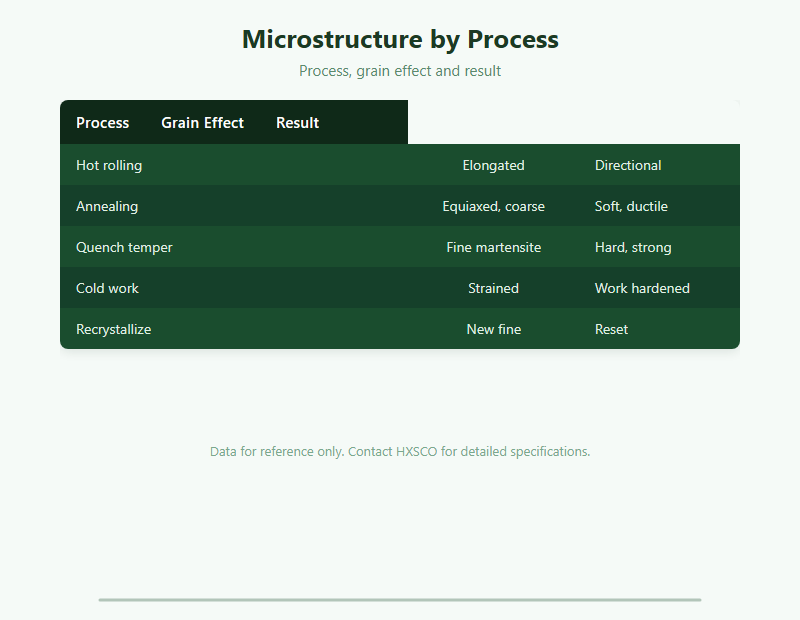
Short answer: Grain size, shape and orientation set a metal strength, toughness and corrosion behaviour; rolling elongates grains for directional properties, annealing coarsens them for softness, quench and temper makes fine martensite for strength, and recrystallization resets the structure.
At a Glance
Why Grains Matter
Fine grains raise strength and toughness while coarse grains raise ductility, with the strength link in our Perbandingan Kekuatan and hardness in our Hardness Comparison.
Process and Shape
Rolling and forging elongate grains along the flow, giving directional properties, with the forming basis in our Extrusion Process Guide dan Sheet Fabrication Guide; cold work is in our Stamping Guide.
Heat Treatment Control
Annealing, quench and temper, and recrystallization set the final grain, detailed in our Heat Treatment Guide; the grade effect is in our 17-4 PH Stainless page.
Specifying and Sourcing
Buyers call out grain size or process when properties matter, then confirm with our Quality Inspection Guide dan Mill Test Certificate Guide, packed per our Export Packing Guide.
Get a Quote
Tell HXSCO your requirements and we will respond with a competitive quote and lead time.
Pertanyaan yang Sering Diajukan
Yes – the Hall-Petch effect makes finer grains stronger and often tougher.
Deformation elongates grains along the rolling direction, giving anisotropic properties.
It forms new equiaxed grains, softening the metal and raising ductility.
It makes fine martensite then tempers it for strength with toughness.
Yes – standards define grain size classes for critical strength or toughness parts.
Source Grain-Controlled Metal with HXSCO
HXSCO supplies rolled, annealed and heat-treated metal with controlled grain structure and the certificate your strength and toughness needs require. Send your spec for a quote.