


Short answer: Weld distortion is the shrinkage of heated metal as it cools, pulling the joint out of shape; it is controlled by lower heat input, balanced weld sequencing, jigging, pre-bending and, where needed, stress relief — the same discipline behind sound {il(‘weld-defects-guide’)} work.
At a Glance
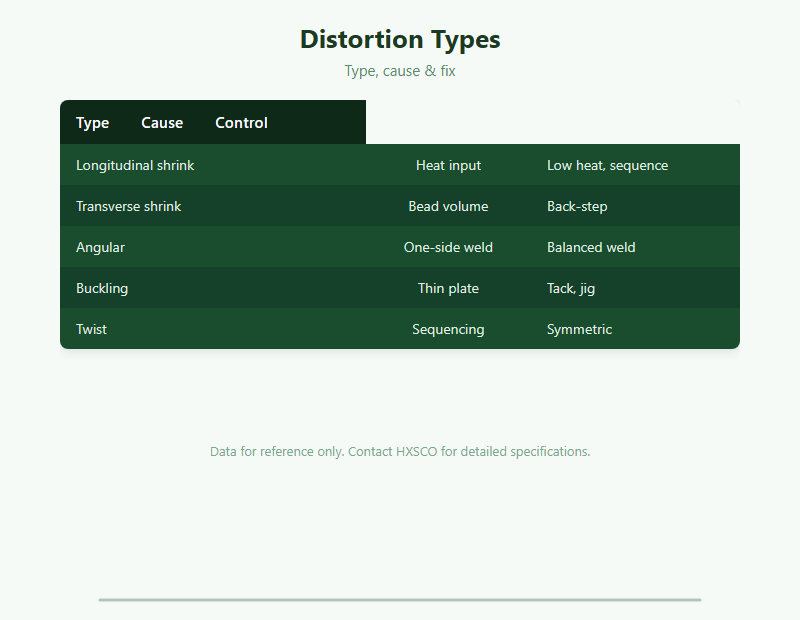
Why Welds Distort
As the arc heats the joint it expands, then contracts on cooling and pulls the plates. More heat and more filler mean more pull — the reason How To Weld Carbon Steel, How To Weld Stainless Steel et Comment souder l'aluminium all stress controlled parameters. Carbon sensitivity is captured by Steel Carbon Equivalent Guide.
Design & Sequencing
Use back-step and symmetric sequences, weld both sides to balance angular change, tack and jig thin plate to stop buckling, and pre-bend to absorb shrinkage. Where welding is hard, consider Metal Riveting Guide ou Metal Bending Guide, and relieve residual stress with Stress Relieving Vs Annealing. For mixed metals follow Dissimilar Metal Welding Guide.
Correction & Quality
Minor distortion is corrected by controlled straightening; verify hardness and soundness with Metal Hardness Testing Methods et Metal Ndt Guide, and certificate per Mill Test Certificate Guide. Protect the finished assembly with How To Prevent Metal Rust.
Get a Quote
Tell HXSCO your requirements and we will respond with a competitive quote and lead time.
Questions fréquemment posées
Non-uniform heating and cooling: the welded zone shrinks as it cools and pulls the surrounding metal out of position; more heat and filler mean more distortion.
Lower heat input, balanced and symmetric weld sequences, back-step welding, jigging/tacking thin plate, and pre-bending to抵消 shrinkage.
Longitudinal is along the weld length from cooling shrinkage; angular is a tilt across the joint when welding one side of a plate.
Yes — by controlled mechanical straightening or heat shrinking, then verified by NDT and hardness checks; severe cases may need rework.
HXSCO supplies plate and sections with certified chemistry and prepared edges to support low-distortion welding procedures.
Source Weld-Ready Steel from HXSCO
HXSCO supplies plate, sections and pipe with certified chemistry and prepared edges for low-distortion welding. Send your joint, grade and quantity for a quote.