


Short answer: Vacuum heat treatment hardens, anneals and brazes parts in a near-oxygen-free chamber, giving bright, scale-free, decarburisation-free surfaces with low distortion — the standard for precision tools, aerospace and medical components.
At a Glance
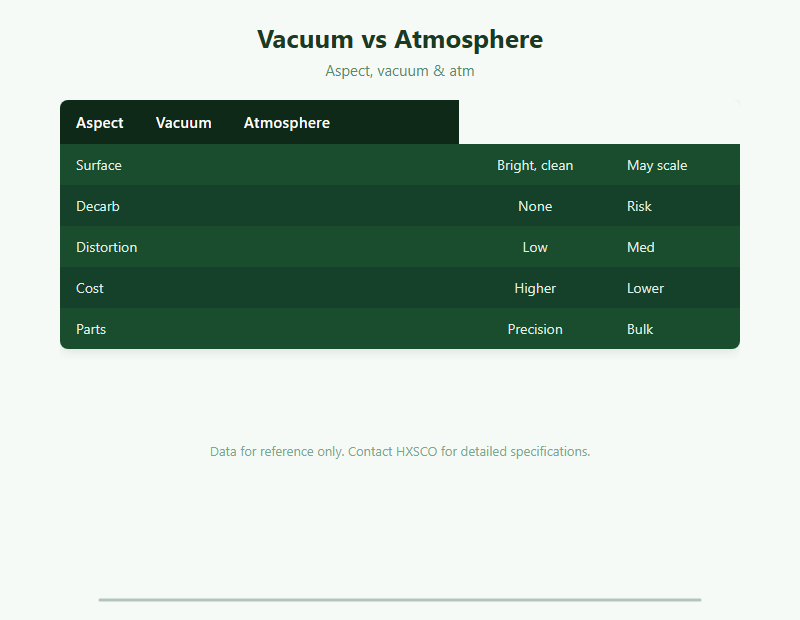
Why Vacuum
The absence of oxygen prevents oxidation and decarburisation, so parts come out bright and dimensionally stable — contrast with open Metal Heat Treatment Guide et Quenching Media Guide. It is the clean partner to Stress Relieving Vs Annealing, Annealing Vs Normalizing et Metal Recrystallization Temperature Guide.
Processes in Vacuum
Vacuum hardening, tempering, annealing and Metal Brazing Vs Soldering of stainless, tool steel (Tool Steel Supplier, H13 Vs D2 Tool Steel) and superalloys (Nickel Alloy Supplier, Hastelloy Guide). Cooling gas or oil quench is controlled; relate to Steel Hardness Vs Strength Guide et Metal Residual Stress Guide.
QA & Supply
Verify hardness, case and dimension with Metal Hardness Testing Methods et Metal Ndt Guide, document per Mill Test Certificate Guide. HXSCO supplies vacuum-treated components and clean stock for the process.
Get a Quote
Tell HXSCO your requirements and we will respond with a competitive quote and lead time.
Questions fréquemment posées
Hardening, annealing or brazing performed in an evacuated, near-oxygen-free chamber for clean, bright parts.
It avoids scaling and decarburisation and gives lower distortion on precision parts.
Tool steels, stainless, precipitation-hardening and nickel superalloys for aerospace and medical use.
Yes — with no oxygen, the surface carbon is preserved and the part stays bright.
HXSCO supplies vacuum-hardened and brazed components with documented hardness and dimensions.
Source Vacuum-Treated Metal from HXSCO
HXSCO supplies vacuum-hardened, annealed and brazed components with bright, decarburisation-free surfaces. Send your specification and quantity for a quote.