


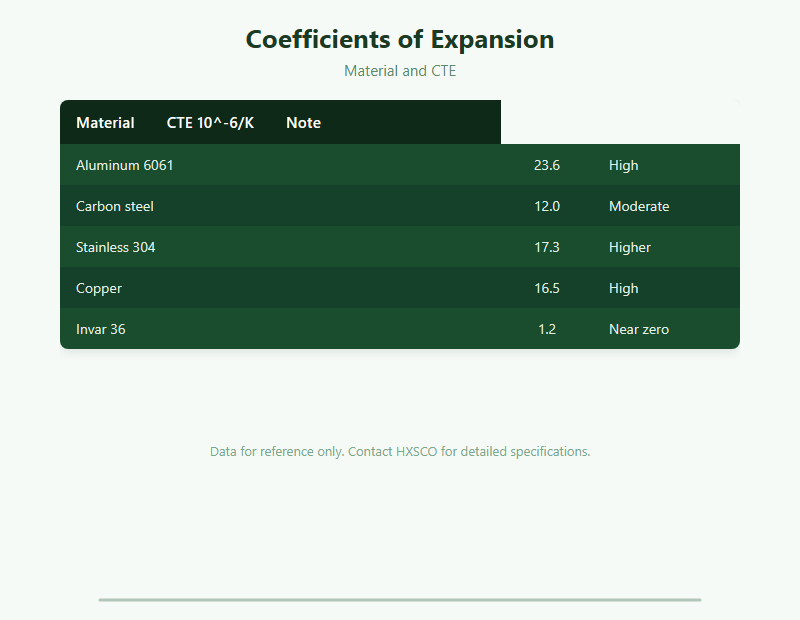
Short answer: Metals grow as they heat, measured by the coefficient of thermal expansion: aluminum is high near 23.6, copper about 16.5, stainless 17.3, carbon steel about 12.0 and Invar near 1.2, so designers allow movement, choose matched metals, or use low-expansion alloys where stability matters.
At a Glance
Why Expansion Matters
Unmanaged expansion buckles pipes and gaps joints; the strength data is in our Comparaison des forces, the alloy base in our Qu'est-ce que l'alliage d'aluminium ? and the grade families in our Types and Grades of Steel.
CTE by Material
Aluminum and copper expand most, steel less, Invar almost not; the stock is in our Aluminum Supplier, Copper Supplier et Stainless Steel Supplier, and the conductor angle in our Busbar Copper vs Aluminium guide.
Design Rules
Allow expansion loops, matched metals and slip joints; the standards are in our Standards Comparison, the pipeline side in our API 5L Line Pipe and dimensional limits in our Tolerances Guide.
Bimetal and Compensation
Bimetal uses the mismatch on purpose and Invar gives stability; the corrosion care is in our Corrosion Resistance Guide, fatigue in our Fatigue Guide and packing in our Export Packing Guide.
Get a Quote
Tell HXSCO your requirements and we will respond with a competitive quote and lead time.
Questions fréquemment posées
Aluminum — about 23.6 x10^-6/K, roughly double steel.
Precision and stable parts needing near-zero expansion.
Expansion loops, slip joints and matched metals in the design.
Copper and aluminum expand differently, stressing joints when hot.
Yes — 304 stainless is about 17.3 versus 12.0 for carbon steel.
Design for Expansion with HXSCO
HXSCO supplies aluminum, copper, stainless and low-expansion alloys for thermally stable designs. Send the duty and we will recommend a grade and quote.