


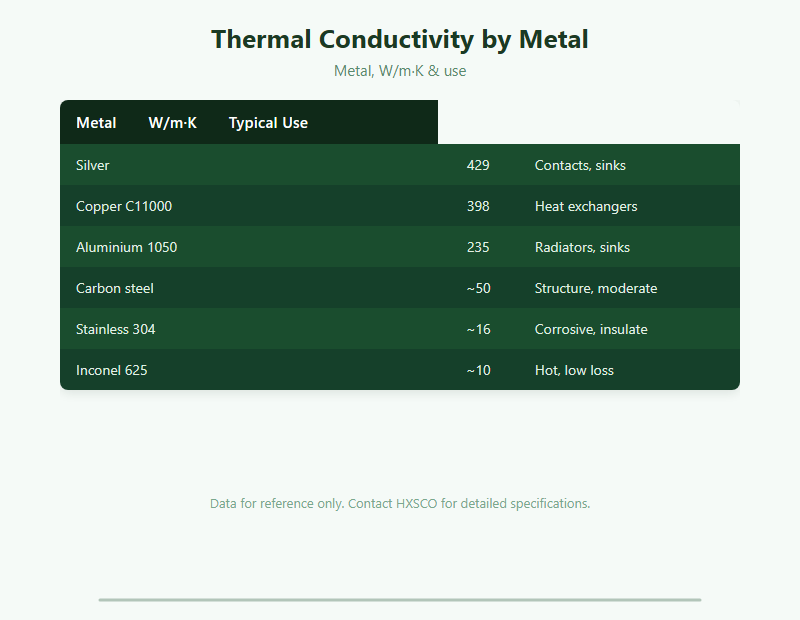
Short answer: Thermal conductivity ranks metals from silver at about 429 W/m·K through copper at 398 and aluminium at 235 down to stainless 304 at about 16 and nickel alloys below 10 — so heat exchangers use copper or aluminium while hot, corrosive duty uses low-conductivity stainless or nickel.
At a Glance
How Metals Conduct Heat
Thermal conductivity (λ, W/m·K) measures how fast heat flows through a material for a given temperature gradient. It tracks electrical conductivity in pure metals — the same free electrons carry both — so the ranking mirrors Metal Electrical Conductivity Guide, while expansion behaviour follows Thermal Expansion Of Metals. Alloying scatters electrons and drops λ sharply: pure copper is near 400, but add zinc or nickel and it falls fast.
Copper vs Aluminium vs Steel
Copper from our Copper Supplier line (C11000 ≈ 398 W/m·K) is the industrial heat-transfer default for exchangers and busbar, with the aluminium trade-off in Copper Vs Aluminum Wire et Busbar Copper Vs Aluminum. Aluminium 1050/1350 (≈235) is lighter and cheaper, which is why Aluminum Supplier et Aluminum Coil Supplier stock cools radiators and electronics; the full conductor contrast is in those guides. Carbon steel sits near 50 and stainless 304 near 16, so steel is a structural material that only modestly conducts heat.
When Low Conductivity Helps
Sometimes you want the heat to stay put. Stainless Steel 304 Properties et Inconel 600 Vs 625 keep heat local in furnace and exhaust duty, which couples with the creep limits in Metal Creep Guide. Joining a high- and low-conductivity metal drives a steep thermal gradient at the joint, so plan the transition with Dissimilar Metal Welding Guide.
Get a Quote
Tell HXSCO your requirements and we will respond with a competitive quote and lead time.
Questions fréquemment posées
Silver is highest at about 429 W/m·K, followed by copper at 398 and aluminium at 235. Copper is the industrial choice for heat exchangers because silver and gold cost far more.
Not identical, but they track closely in pure metals because the same free electrons carry both. Alloying lowers both, which is why stainless conducts neither well.
Heavy alloying with chromium and nickel scatters electrons, dropping 304 to about 16 W/m·K — far below copper — so stainless heats and cools unevenly and is chosen for corrosion resistance, not heat transfer.
Copper for maximum performance; aluminium 1050/1050A or 6061 for lighter, cheaper sinks where the small conductivity loss is acceptable.
Yes. HXSCO supplies C11000 copper and 1050/1350 aluminium with conductivity and mill certificates for heat-transfer and electrical duty.
Source Thermal-Grade Metal from HXSCO
HXSCO supplies C11000 copper and 1050/1350 aluminium with certified conductivity for heat-exchanger and sink applications. Send your duty and quantity for a quote.