



Short answer: Normalizing defects — coarse grains from overheating, surface oxidation and decarburization, distortion and scale — come from poor temperature and atmosphere control. Most are avoided by correct soak temperature, protective atmosphere and uniform cooling, then caught by hardness and microstructural checks.
At a Glance
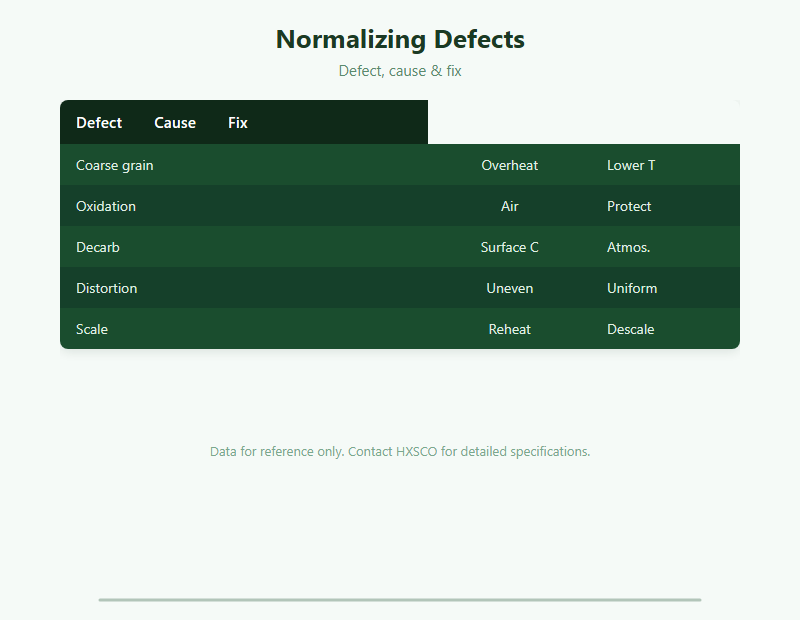
Where Defects Start
Normalizing is a Metal Heat Treatment Guide step beside Annealing Vs Normalizing et Stress Relieving Vs Annealing; grain control links to Metal Grain Size Guide et Metal Recrystallization Temperature Guide.
Controlling the Furnace
Lower soak temperature and protect atmosphere; inspect by Metal Ndt Guide and document per Mill Test Certificate Guide. Relate to Metal Wear Mechanisms Guide for service life.
QA & Supply
Protect stock via How To Prevent Metal Rust. HXSCO supplies normalized grades inspected for soundness.
Get a Quote
Tell HXSCO your requirements and we will respond with a competitive quote and lead time.
Questions fréquemment posées
Heating above transformation then air-cooling to refine grains.
Soaking above the correct temperature grows the austenite grain.
Controlled (low-decarb) atmosphere during the soak.
Uneven cooling stresses the part; uniform cooling reduces it.
HXSCO supplies normalized grades with grain and hardness checked.
Source Normalized Steel from HXSCO
HXSCO supplies normalized steel grades with grain size and hardness controlled to your drawing. Send your grade and quantity for a quote.