


Short answer: Induction hardening uses a high-frequency magnetic field to rapidly heat just the surface of a steel part, then quenches it in place for a hard, wear-resistant case with almost no distortion to the soft, tough core.
At a Glance
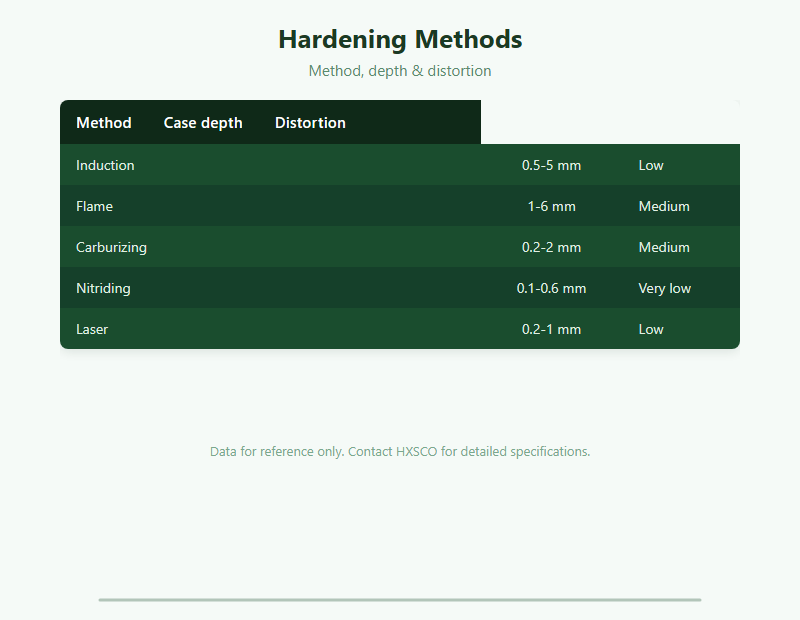
How It Works
A copper coil induces eddy currents that heat the skin in seconds; the part is spray-quenched before the core warms. It is a partner to Nitriding Vs Carburizing et Metal Austempering Guide and follows the strength logic in Yield Strength Vs Tensile Strength et Metal Fatigue Endurance Limit; relate to Metal Surface Treatment Guide.
Where It Pays Off
Shafts, gears, cam lobes and rail heads gain a hard case with a ductile core; tie wear resistance to Metal Wear Mechanisms Guide, check depth by Metal Hardness Testing Methods, and finish per Steel Hardness Vs Strength Guide et Metal Burr Deburring Guide.
QA & Supply
Confirm case depth and cracks by Metal Ndt Guide, document per Mill Test Certificate Guide, and protect via How To Prevent Metal Rust. HXSCO supplies hardening-grade bars matched to the process.
Get a Quote
Tell HXSCO your requirements and we will respond with a competitive quote and lead time.
Questions fréquemment posées
A high-frequency field heats only the surface, which is then quenched for a hard, wear-resistant case.
Carbon and low-alloy steels, and some cast irons, that respond to quench hardening.
Only the thin surface is heated and quenched, so the core stays cool and stable.
Typically 0.5 to 5 mm, controlled by frequency, power and scan speed.
HXSCO supplies bars and blanks in grades selected for induction hardening.
Source Hardening-Grade Steel from HXSCO
HXSCO supplies bars and blanks in grades selected for induction hardening and low distortion. Send your grade and quantity for a quote.