



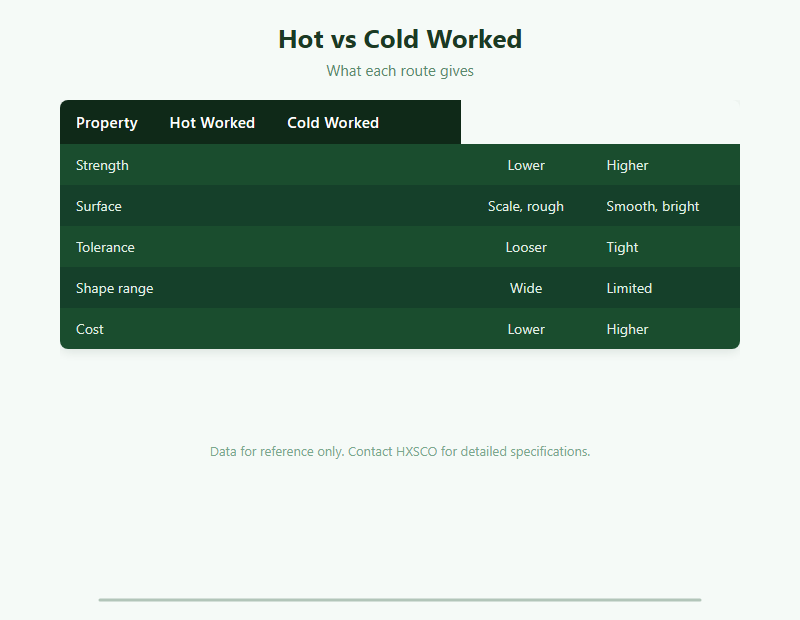
Short answer: Hot working shapes metal above recrystallization for low cost and wide shapes, while cold working adds strength and a smooth, tight-tolerance finish, so the route depends on the part’s tolerance and property needs; our Hot vs Cold Rolled Guide et Heat Treatment Guide give the detail.
At a Glance
Process Basics
Hot working rolls or forges above recrystallization; cold working draws or rolls at room temperature. The rolling basis is in our Hot vs Cold Rolled Guide and sourcing in our Steel Coil Supplier et Steel Sheet Supplier.
Property Trade-offs
Cold work raises strength and hardness but lowers ductility; data is in our Comparaison des forces et Hardness Comparison, with relief in our Heat Treatment Guide.
Surface and Tolerance
Cold-finished bar and strip give smooth, tight-tolerance stock from our Metal Strip Supplier et Metal Bar Supplier; finishing is in our Surface Treatment Guide.
Choosing a Route
Use hot work for structural volume, cold work for precision and strength; certify per our Mill Test Certificate Guide et Export Packing Guide.
Get a Quote
Tell HXSCO your requirements and we will respond with a competitive quote and lead time.
Questions fréquemment posées
Cold worked – strain hardening raises strength and hardness.
Cold worked – smooth and bright, often scale-free.
Hot worked for most structural volumes.
Yes – annealing relieves strain hardening.
Use cold-finished grades and a tolerance class in the PO.
Buy Hot or Cold Worked Metal from HXSCO
HXSCO supplies hot-rolled and cold-finished steel, stainless and aluminum in coil, sheet, bar and strip. Send spec and tolerance for a quote.