


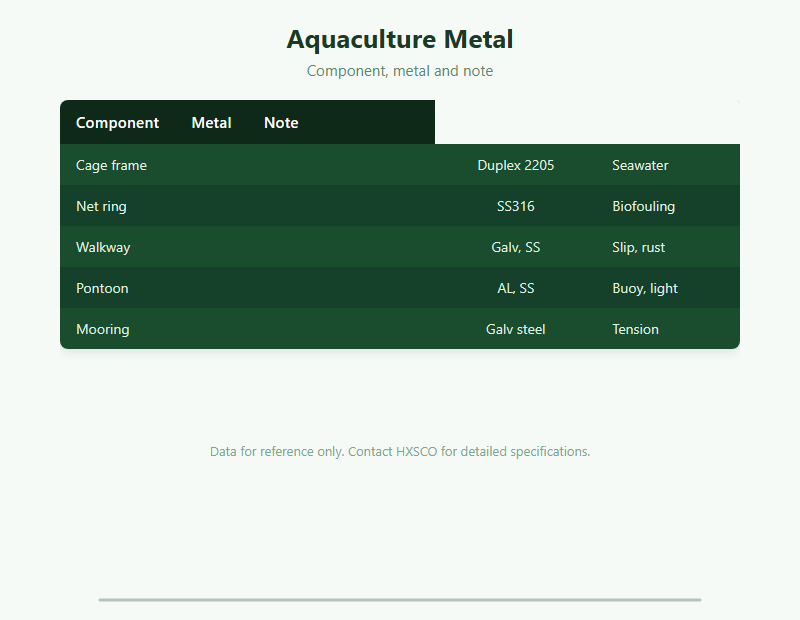
Short answer: Aquaculture uses duplex 2205 and 316 stainless for cage frames and net rings in seawater, galvanized or stainless for walkways and pontoons, and galvanized steel for mooring, chosen for chloride resistance, biofouling control and long service in a wet, salty environment.
At a Glance
The Seawater Challenge
Chloride, biofouling and constant wetness attack the metal, so alloy choice is critical, with data in our Corrosion Resistance Guide and the marine context in our Marine and Offshore Guide.
Cages and Nets
Duplex and 316 resist pitting and fouling, detailed in our Duplex Stainless Supplier et Stainless Steel Supplier pages; corrosion care is in our Corrosion Protection Guide.
Walkways and Welding
Walkways and pontoons need slip resistance and weld soundness, with joining in our Welding Joining Guide et Stainless Steel Welding Guide; galvanized options are in our Galvanized Steel Supplier range.
Standards and Sourcing
Marine grades follow ASTM and EN rules, with checks in our Standards Comparison Guide; certification is in our Mill Test Certificate Guide and packing in our Export Packing Guide.
Get a Quote
Tell HXSCO your requirements and we will respond with a competitive quote and lead time.
Questions fréquemment posées
Duplex 2205 resists pitting and crevice corrosion in seawater.
316 works for lighter duty; duplex is better for main frames.
Galvanized steel is economical and slip-resistant when treaded.
Fouling traps moisture and speeds crevice corrosion; alloys resist better.
PMI and EN 10204 3.1 certificate confirm chemistry and service.
Source Aquaculture Metal with HXSCO
HXSCO supplies duplex, 316 stainless, galvanized and aluminium for cages, nets, walkways and pontoons. Send your seawater duty for a quote.