


Short answer: Centrifugal casting pours molten metal into a rapidly rotating mould so centrifugal force packs the metal against the wall, pushing inclusions and porosity to the bore and producing dense, clean, fine-grained tubes, rings and bushings with excellent mechanicals. True centrifugal casting makes pipe and tube, semi-centrifugal makes rings and wheels, and vertical casting makes short sleeves — widely used for bearing races, cylinder liners and wear sleeves in steel, iron, bronze and stainless.
At a Glance
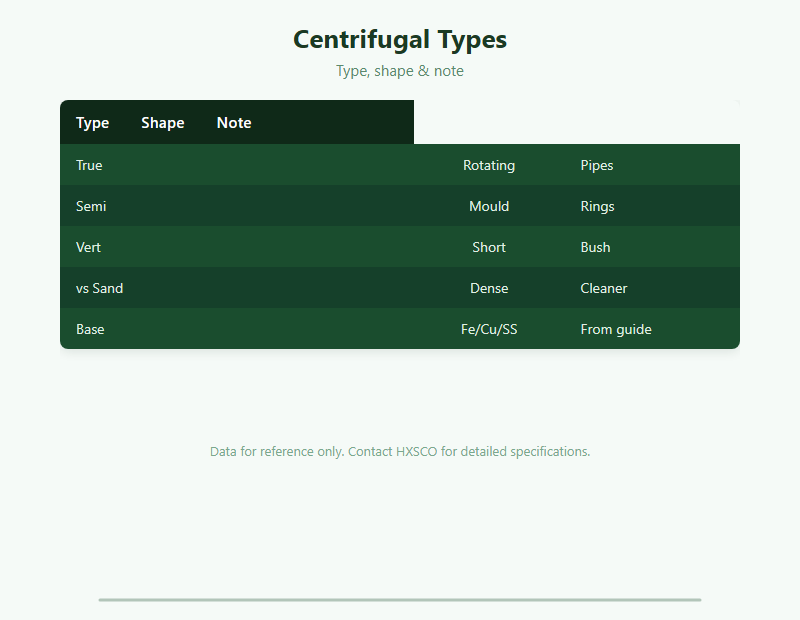
Centrifugal vs Other
Relate to Casting Supplier, Metal Sand Casting Guide, Metal Permanent Mold Casting Guide et Metal Die Casting Guide.
Qualité
Soundness checked by Metal Ndt Guide, certified by Mill Test Certificate Guide.
Supply & QA
Protect via How To Prevent Metal Rust et Metal Corrosion Inhibitor Guide. HXSCO supplies casting-grade stock.
Get a Quote
Tell HXSCO your requirements and we will respond with a competitive quote and lead time.
Questions fréquemment posées
Metal poured into a spinning mould; force packs it to the wall.
Pipe, tube, rings, bushings and wear sleeves.
Porosity and inclusions migrate to the bore (machined off).
Steel, iron, bronze and stainless all run well.
HXSCO supplies iron, steel and bronze melt stock.
Source Casting-Grade Metal from HXSCO
HXSCO supplies steel, iron and bronze melt stock for dense centrifugal castings. Send your alloy and quantity for a quote.