


Short answer: Intergranular (or intergranular) corrosion in stainless steel is attack along the grain boundaries caused by chromium carbide precipitation in the 430–870 °C range, which depletes chromium at the grain edges; it is prevented by using low-carbon (L) grades, stabilised grades (321/347), or solution-annealing after heating.
At a Glance
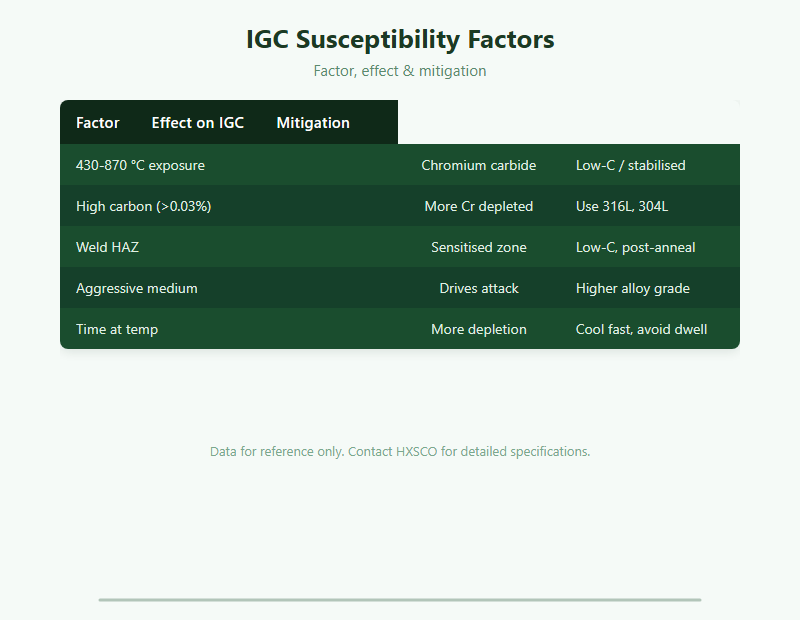
What Intergranular Corrosion Is
When stainless is held or slowly cooled through roughly 430–870 °C — during welding, heat treatment or service — chromium combines with carbon to form carbides at the grain boundaries, leaving a chromium-depleted rim that can no longer maintain its passive film. Attack then runs along those boundaries, sometimes with little surface warning. It is a sibling of Crevice Corrosion Stainless Steel et Pitting Corrosion Stainless Steel, but driven by heat history rather than geometry; the grade system behind it is in Explication des nuances d'acier inoxydable.
Where It Happens
The classic site is the heat-affected zone (HAZ) of a weld in non-low-carbon grades — the weld itself may be fine while the adjacent sensitised band corrodes. It also occurs in service where a component dwells in the sensitising range, and in improperly cooled heat-treated parts. The welding routes that create the HAZ are in How To Weld Stainless Steel et How To Weld Carbon Steel; fast cooling and low heat input reduce the dwell. Susceptibility also rises with carbon content and chloride level, which is why Stainless Steel 316 Properties is usually specified as 316L.
Preventing It
Specify low-carbon (L) grades — 304L, 316L — so there is too little carbon to deplete the boundaries; use stabilised grades 321 (Ti) or 347 (Nb) that tie up carbon; or solution-anneal (quench from ~1050 °C) after any sensitising heat. Good passivation (see Passivation Vs Pickling) and the right surface finish (see Stainless Steel Surface Finishes) help, and for severe duty move to Duplex Stainless Steel Guide or a nickel alloy. Every lot is confirmed by the certificate in Mill Test Certificate Guide and, where required, an ASTM A262 practice test.
Get a Quote
Tell HXSCO your requirements and we will respond with a competitive quote and lead time.
Questions fréquemment posées
It is corrosion along the grain boundaries caused by chromium-carbide precipitation in the 430-870 °C range, which depletes chromium at the grain edges and breaks the passive film there.
Holding or slowly cooling stainless through the sensitising temperature range (especially during welding or heat treatment) lets carbon combine with chromium at the grain boundaries, leaving chromium-depleted, attack-prone zones.
Use low-carbon L grades (304L, 316L), stabilised grades (321, 347), or solution-anneal after heating; control weld heat input and avoid dwelling in the sensitising range.
Low-carbon 316L and 304L, plus stabilised 321/347, resist it well; for severe duty duplex or nickel alloys are preferred.
Specify IGC-Resistant Stainless from HXSCO
HXSCO supplies 304L, 316L, 321 and 347 stainless with low intergranular-corrosion risk and mill certificates (ASTM A262 on request). Send your weld and service for a quote.