


Short answer: Design for additive manufacturing means setting wall thickness, supports, escape holes and orientation for a clean build, supported by the printing service in our Metal 3D Printing Supplier page and the process detail in our SLM/DMLS Guide.
At a Glance
Why DfAM Matters
Good design cuts supports, build time and scrap; poor design causes warping or unmelted edges, with the process basis in our 3D Metal Printing Guide.
Core Rules
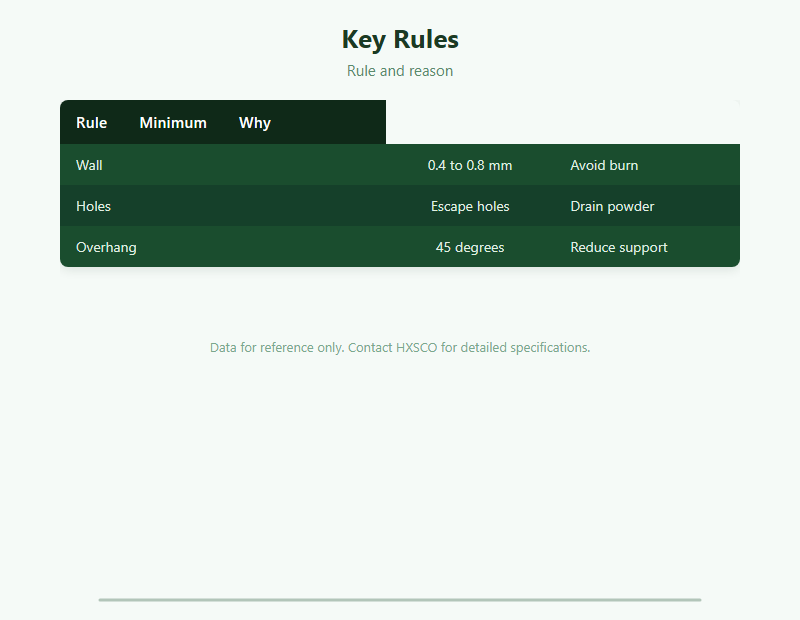
Keep walls at 0.4 to 0.8 mm, add escape holes to drain trapped powder, and limit overhangs to about 45 degrees to reduce supports, with the comparison in our AM vs CNC Guide.
| Rule | Minimum | Why |
|---|---|---|
| Wall | 0.4 to 0.8 mm | Avoid burn |
| Holes | Escape holes | Drain powder |
| Overhang | 45 degrees | Reduce support |
Orientation and Supports
Part orientation balances accuracy, support use and build height; we review models before build, with the post steps in our AM Post-Processing Guide.
Lightweighting
Lattices and topology optimization cut mass while keeping stiffness, with the alloy basis in our Alloy Steel Supplier page.
Quality and Inspection
Design is checked against build rules and the part verified, with the method in our AM Quality Inspection Guide.
Buyer Checklist
Share STEP/STL, duty and tolerance; plan quantity and timing with our MOQ and Lead Time Guide and price with our Price Quotation Guide.
Get a Quote
Tell HXSCO your requirements and we will respond with a competitive quote and lead time.
Questions fréquemment posées
Around 0.4 to 0.8 mm.
To drain trapped powder.
About 45 degrees before supports.
Yes – lattices and topology.
Yes – before build.
Design and Print with HXSCO
HXSCO reviews your model for additive manufacturing and prints it with inspection reports. Send your STEP/STL and duty for a quote.