


Short answer: Copper bar and rod are solid sections used for electrical conduction and machining. Round rod, square bar, flat busbar, and hex bar are stocked mainly in high-conductivity C11000, with oxygen-free C10200 for welding. They serve busbars, earthing, terminals, and machined electrical parts.
At a Glance
What Are Copper Bars and Rods?
Bar and rod are solid, long copper sections. ‘Rod’ usually means round; ‘bar’ covers square, flat, and hex shapes. They are produced by extrusion, rolling, or drawing, then cut or machined. Because copper conducts so well, these sections are the backbone of electrical distribution and earthing.
Bar Shapes
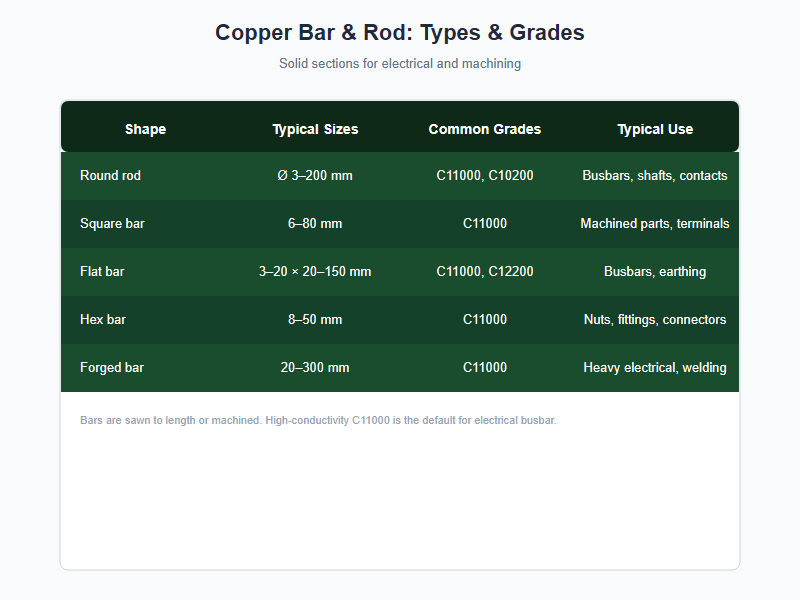
The chart above lists the main shapes. Round rod is used for shafts, contacts, and turned parts. Square and hex bar suit machined terminals, nuts, and fittings. Flat bar is the classic busbar and earthing conductor. Forged bar serves heavy electrical and welding applications.
Choosing a Grade
High-conductivity C11000 (ETP) is the default for busbar and general electrical use. Oxygen-free C10200 is preferred where the bar will be welded or brazed, because it avoids hydrogen embrittlement. For machined fittings, brass alloys (see our fournisseurs de barres en laiton page) are often paired with copper in the same assembly.
Electrical Uses
- Busbars: Flat copper bar distributes current in switchgear and panels.
- Earthing: Copper bar and rod give a low-resistance ground path.
- Terminals & connectors: Machined from rod and hex bar.
- Welding: Oxygen-free rod for conductive seams.
Ordering Copper Bar from HXSCO
State the shape, grade, dimensions, length, tolerance, and quantity. HXSCO can saw to length, machine, and supply mill-test certificates. Request a quote with your drawing or BOM.
Questions fréquemment posées
Rod usually means round solid section; bar covers square, flat, and hex shapes. Both are solid long products.
High-conductivity ETP C11000 is the standard busbar grade; use oxygen-free C10200 if the bar will be welded.
Yes. Copper bar and rod provide a durable, low-resistance earthing and bonding conductor.
Common diameters run from about 3 mm to 200 mm, supplied in mill lengths or cut to your required length.
Yes. Copper machines readily, though it is gummy; sharp tooling and proper speeds give clean turned parts and terminals.
Ready to source copper or copper alloys?
Tell us the grade (C11000, C12200, brass, etc.), form, size, quantity, and destination. HXSCO will reply with a competitive quote, lead time, and mill-test options.
Request a QuoteWhy Buyers Source Copper & Copper Alloys from HXSCO
HXSCO supplies copper and copper-alloy long products and fabricated parts to manufacturers, electrical contractors, and trading companies worldwide. We stock ETP (C11000), oxygen-free (C10200), and DHP (C12200) copper plus brass and bronze alloys in sheet, plate, pipe, tube, bar, rod, and wire. Material can be supplied with mill-test certificates, precision cutting, and export packing. Contact HXSCO for a project-specific quote or grade recommendation.