


Short answer: Brass (Cu-Zn alloy, 5–45% zinc) offers better machinability, lower cost, and decorative gold appearance. Pure copper (99.9%+ Cu) delivers superior electrical/thermal conductivity, antimicrobial properties, and corrosion resistance in neutral environments. Choose brass for fittings, valves, and decoration; choose copper for electrical wiring, heat exchangers, and plumbing.
At a Glance
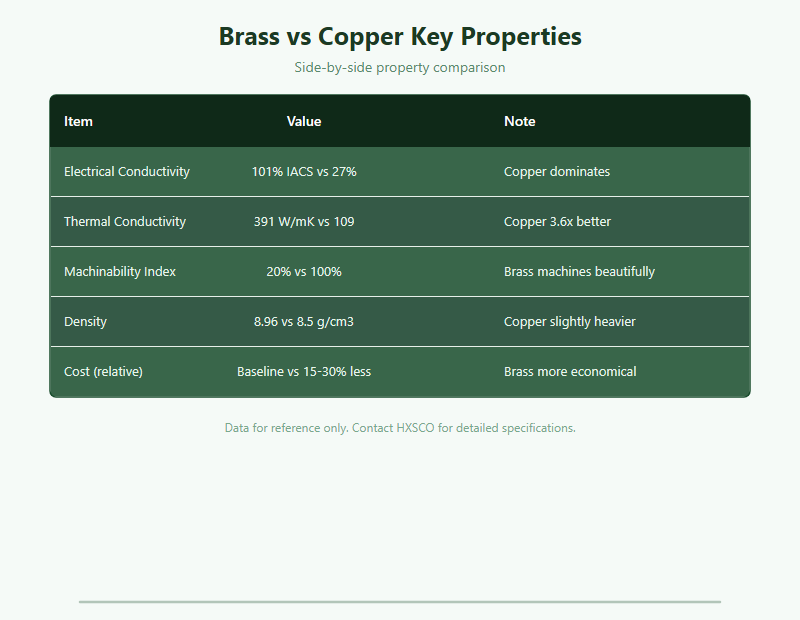
Composition & Basic Properties
| Propriété | Copper (ETP/C11000) | Brass (CZ121/C36000) |
|---|---|---|
| Composition | ≥99.9% Cu | ~61% Cu, ~35% Zn, ~3% Pb |
| Electrical conductivity | 101% IACS | 27% IACS |
| Conductivité thermique | 391 W/m·K | 109 W/m·K |
| Densité | 8.96 g/cm³ | 8.5 g/cm³ |
| Machinability index | 20% | 100% (free-machining) |
| Cost (relative) | Baseline (higher) | ~15–30% less than copper |
When to Choose Copper
Electrical applications: Busbars, windings, grounding conductors, earthing systems — nothing matches copper’s conductivity. See copper grades guide.
Heat transfer: Heat exchangers, radiators, HVAC coils, heatsinks, cooking vessel bottoms. Copper’s thermal conductivity is 3.6× that of brass.
Plumbing & potable water: Type M/L/K copper tubing is the global standard for domestic water supply — safe, long-lasting, biostatic.
Antimicrobial surfaces: Healthcare touch surfaces, food processing equipment — copper kills >99.9% of bacteria within 2 hours (EPA registered).
Roofing & flashing: Architectural copper develops a distinctive green patina (verdigris) and lasts 100+ years.
When to Choose Brass
Machined components: Valves, fittings, fasteners, gears, meter casings — brass machines beautifully with excellent chip formation. Brass types guide.
Decorative applications: Door handles, musical instruments (trumpets, saxophones), jewelry, lighting fixtures, nautical hardware — the gold-like appearance is prized.
Low-friction bearings: Bushings, thrust washers, bearing shells — leaded brass offers self-lubricating properties.
Marine hardware: Naval brass and aluminum bronze resist seawater corrosion. Propeller shafts, pump impellers, valve components.
Ammunition casings: Cartridge brass (C26000, 70% Cu / 30% Zn) is the standard material for small arms ammunition.
Corrosion Behavior
Copper: Excellent in atmospheric, freshwater, and neutral aqueous environments. Develops protective oxide/sulfate/carbonate patina. Vulnerable to ammonia compounds (stress cracking) and oxidizing acids.
Brass: Generally good corrosion resistance, but susceptible to dezincification in acidic or high-chloride waters (zinc leaches out, leaving porous copper). Marine brass (adding Sn, Al, As) resists this. Stress corrosion cracking possible in ammonia environments.
Get a Quote
Tell HXSCO your requirements and we will respond with a competitive quote and lead time.
Questions fréquemment posées
Yes — brass typically costs 15–30% less than pure copper by weight because zinc (the main alloying element) is cheaper than copper. However, the price fluctuates with both metals’ commodity markets.
Copper is vastly superior — approximately 3.7× the electrical conductivity of typical free-machining brass (101% IACS vs ~27% IACS). Never substitute brass for copper in electrical applications.
Yes, using bronze filler rod (ERCuSn-A or ERCuAl-A2) with TIG or oxy-acetylene. Brazing is also effective. Note that the joint will have properties between the two metals. Avoid direct fusion welding which can cause hot cracking.
Both tarnish when exposed to air and sulfur compounds. Brass develops a dull brownish patina; copper progresses from brown to green (verdigris). Both can be protected with lacquer, wax, or regular cleaning.
Copper is slightly denser (8.96 g/cm³) than brass (8.4–8.7 g/cm³ depending on zinc content). For the same volume, copper weighs about 3–6% more than brass.
Source Brass or Copper from HXSCO
HXSCO supplies copper (sheet, tube, pipe, bar, wire, coil) and brass (rod, sheet, plate, forging stock) in all standard grades. Tell us your application for alloy recommendations and pricing.