



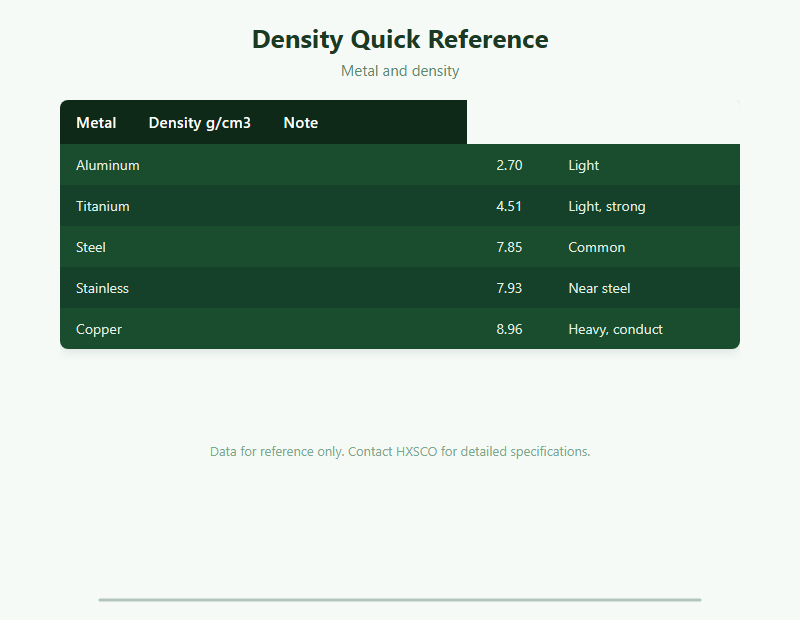
Short answer: Metal weight is the volume times density, so plate weight is length times width times thickness times density, bar weight is cross-section area times length times density and coil weight is width times thickness times length times density, using densities of about 2.70 for aluminum, 4.51 for titanium, 7.85 for steel, 7.93 for stainless and 8.96 for copper, which lets buyers check price per kg, shipping load and crane capacity before ordering.
At a Glance
The Density Method
Volume times density is the core, with the basis in our Density Comparison Guide and strength notes in our Metal Strength Comparison; alloy detail is in our Nickel Alloy Grades Guide.
Plate, Bar and Coil
Each shape uses the same volume rule with its own dimensions, with cutting in our Cutting Processes Guide and machining in our Machining Guide; fabrication context is in our Sheet Fabrication Guide.
Logistics and Price
Weight sets freight class and crane load and underpins per-kg pricing, with packing in our Export Packing Guide and certification in our Mill Test Certificate Guide; quality checks are in our Quality Inspection Guide.
Quality and Sourcing
Weights are checked against order, with methods in our Quality Inspection Guide and packing in our Export Packing Guide.
Get a Quote
Tell HXSCO your requirements and we will respond with a competitive quote and lead time.
Sıkça Sorulan Sorular
Weight equals volume times density of the metal.
About 7.85 g/cm3 for carbon steel.
Length times width times thickness times density.
It sets freight cost, crane load and per-kg price.
Confirm density and dimensions on the certificate.
Quote Metal Weight with HXSCO
HXSCO supplies steel, stainless, aluminum, titanium and copper with weights and certificates for accurate freight and pricing. Send sizes for a quote.