


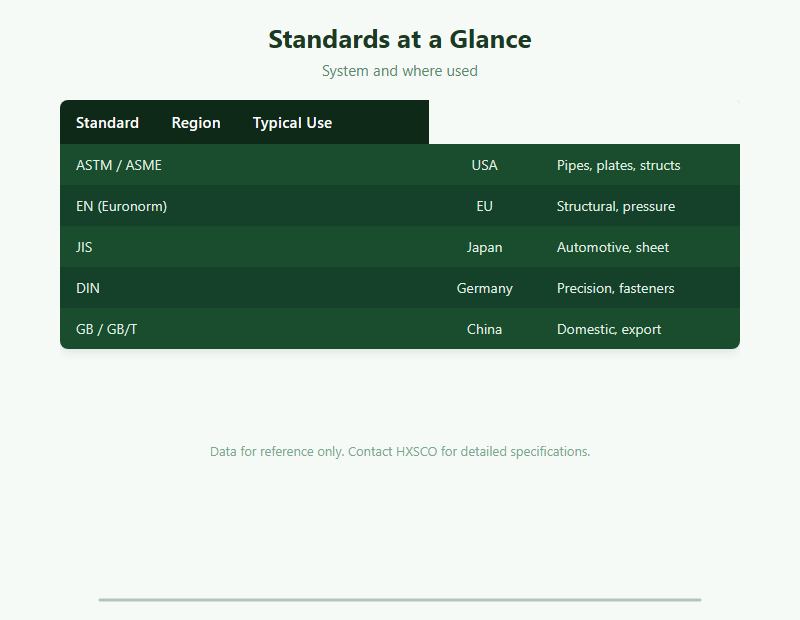
Short answer: Metal is specified to different systems — ASTM and ASME for the US market, EN for Europe, JIS for Japan, DIN for precision parts and GB for China — so buyers compare grades by chemistry and mechanicals, not just the label, and cross-reference before sourcing.
At a Glance
Why Standards Matter
A standard ties chemistry and properties to a grade so orders are repeatable; the grade families are in our Types and Grades of Steel ve Karbon Çelik Çeşitleri, the proof in our Mill Test Certificate Guide and the data in our Güç Karşılaştırması.
ASTM and ASME
ASTM covers material and ASME the pressure-code use, dominant in the Americas; the pipeline side is our API 5L Line Pipe page, stainless in our Stainless Steel Supplier and carbon in our Carbon Steel Supplier.
EN and JIS
EN is the European harmonised system and JIS the Japanese, common in automotive and sheet; the alloy base is in our Nickel Alloy Supplier, corrosion care in our Corrosion Resistance Guide and the comparison in our 304 vs 316 guide.
DIN, GB and Cross-Reference
DIN serves precision and fasteners, GB serves China domestic and export; the standards must map to chemistry and mechanicals, verified by our Mill Test Certificate Guide, dimensional limits in our Tolerances Guide and packing in our Export Packing Guide.
Get a Quote
Tell HXSCO your requirements and we will respond with a competitive quote and lead time.
Sıkça Sorulan Sorular
ASTM in the Americas, EN in Europe, JIS in Japan, GB in China.
Not always — compare chemistry and mechanicals, not just the name.
A cert can list multiple standards where the material satisfies all.
Yes — for precision parts and fasteners it is widely referenced.
Cross-reference chemistry and mechanicals and confirm on the mill cert.
Specify to Standard with HXSCO
HXSCO supplies material to ASTM, EN, JIS, DIN and GB with cross-referenced mill certificates. Send the standard and grade and we will quote.