


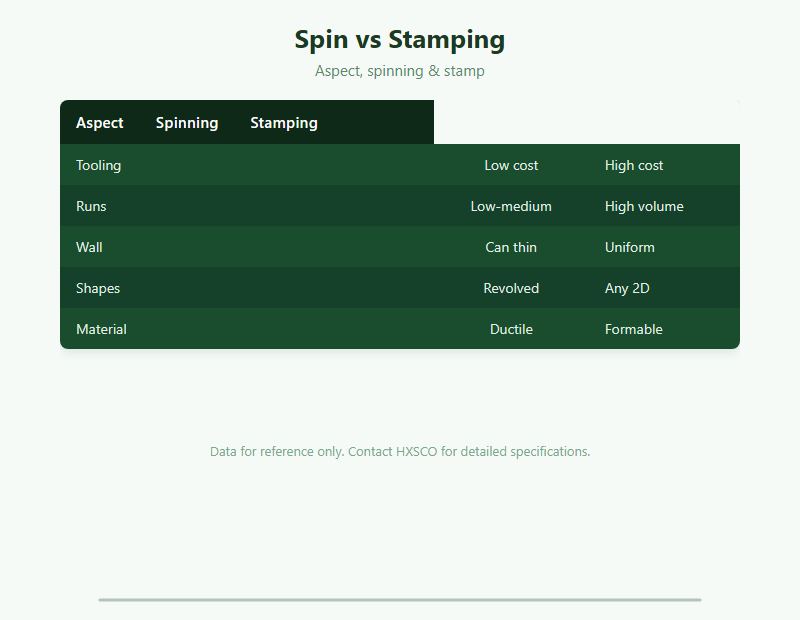
Short answer: Metal spinning forms axisymmetric parts by pressing a spinning disc or tube of sheet against a rotating mandrel — a low-tooling, highly ductile process ideal for cones, domes, vessels and reflectors in low to medium runs.
At a Glance
How Spinning Works
A blank spins on a lathe while a roller presses it onto a mandrel, flowing metal into the shape without a closing die. It is gentler than Metal Stamping Supplier and pairs with Metal Bending Guide; forming limits follow Metal Formability Guide и Aluminum Temper Designations.
Spinning vs Other Forming
Tooling is far cheaper than stamping dies, so spinning suits prototypes and medium runs of revolved parts (compare Casting Supplier и Forging Supplier). Flow forming thins and elongates the wall for strength — context for Yield Strength Vs Tensile Strength и Metal Strain Hardening Guide.
Materials, QA & Supply
Aluminium (Aluminum Alloy Series Guide), stainless (Градации нержавеющей стали с пояснениями), copper (Copper Alloys Guide) and mild steel spin well. Verify dimensions per Metal Tolerances Fits Guide, finish per Surface Roughness Ra Guide and record per Mill Test Certificate Guide.
Get a Quote
Tell HXSCO your requirements and we will respond with a competitive quote and lead time.
Часто задаваемые вопросы
Forming axisymmetric parts by pressing a spinning sheet or tube against a rotating mandrel with a roller.
For low-to-medium runs and prototypes where die tooling cost would be hard to justify.
Cones, domes, cylinders, vessels and reflectors — anything with rotational symmetry.
Ductile metals: aluminium, stainless, copper and mild steel in suitable tempers.
Flow forming can thin and elongate the wall, increasing strength along the part.
Source Spun & Formed Parts from HXSCO
HXSCO supplies spun, flow-formed and stamped revolved parts with documented dimensions and finish. Send your drawing and quantity for a quote.