


Short answer: Laser cladding fuses a powder or wire feed into a thin, metallurgically bonded, low-dilution layer on a metal surface using a focused laser, building up hardfacing, corrosion-resistant or repair deposits with minimal heat and distortion. Unlike thermal spray or electroplating, the clad is fully fused to the substrate, so it survives wear, impact and machining — ideal for rebuilding worn shafts, valve seats and tooling and for surfacing lower-cost base metals with expensive alloys.
At a Glance
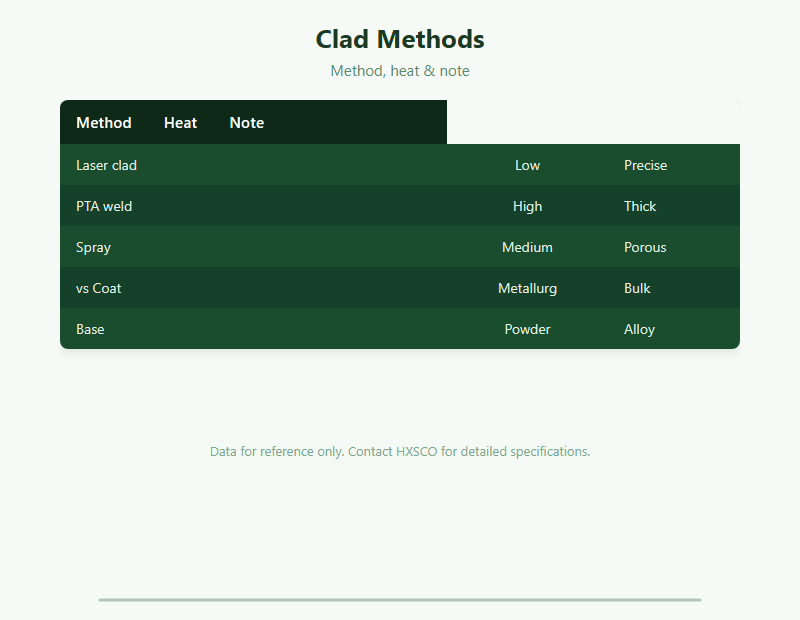
Cladding Methods
Cladding complements Metal Laser Welding Guide и Metal Surface Treatment Guide; relate to Metal Wear Mechanisms Guide и Metal Powder Supplier.
Качество
Layer bond and dilution checked by Metal Ndt Guide, documented per Mill Test Certificate Guide. Compare Metal Tig Vs Mig Welding Guide.
Supply & QA
Control distortion via Metal Residual Stress Guide; protect via Metal Corrosion Inhibitor Guide и How To Prevent Metal Rust. HXSCO supplies clad powder and base stock.
Get a Quote
Tell HXSCO your requirements and we will respond with a competitive quote and lead time.
Часто задаваемые вопросы
Laser-fused hardfacing layer with minimal dilution/heat.
Clad is metallurgically bonded; spray is mechanical, porous.
Worn shafts, valve seats, tooling, rolls, dies.
Yes — low heat input, often no post-machining distortion.
HXSCO supplies laser-cladding powders and base alloys.
Source Cladding Powder from HXSCO
HXSCO supplies laser-cladding powders and base metals for hardfacing and repair. Send your alloy and quantity for a quote.