


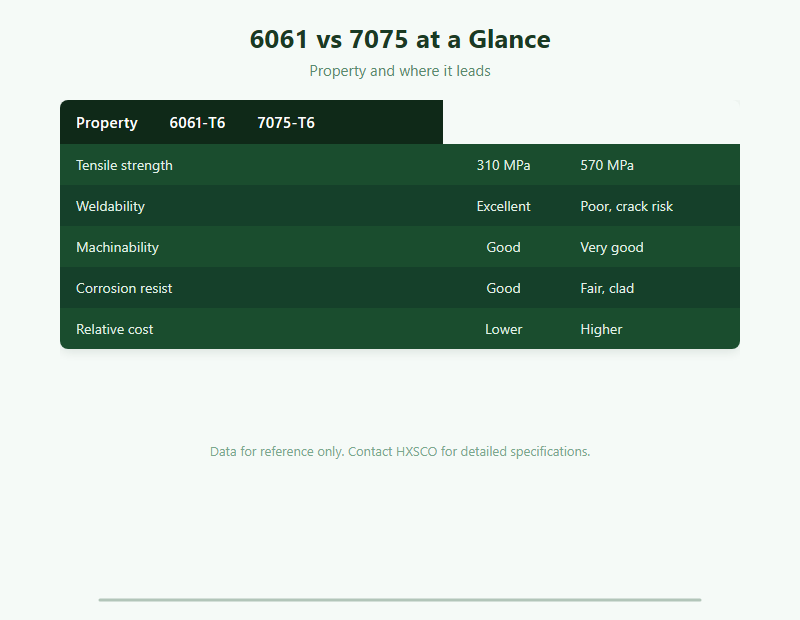
Short answer: Aluminum 6061-T6 offers about 310 MPa tensile strength with excellent weldability and good corrosion resistance at lower cost, making it the default for welded and formed structures, while 7075-T6 reaches about 570 MPa for the strongest airframe and tooling parts but is harder to weld and needs cladding for corrosion service, so the choice turns on strength versus fabrication and budget.
At a Glance
What the Two Alloys Are
Both are heat-treatable 6xxx and 7xxx alloys, with the strength basis in our Metal Strength Comparison and density notes in our Density Comparison Guide; the aluminium basis is in our Aluminium Supplier.
Strength and Use
7075 leads where weight and load matter and 6061 leads where welding and forming matter, with fatigue notes in our Metal Fatigue Guide and aerospace context in our Aerospace Guide.
Fabrication
6061 welds and machines readily and 7075 machines very well but welds poorly, with machining in our Machining Guide and cutting in our Cutting Processes Guide; finish is in our Anodizing vs Powder Coating Guide.
Quality and Sourcing
Alloy stock is checked by inspection, with methods in our Quality Inspection Guide; buyers confirm temper via our Mill Test Certificate Guide and pack per our Export Packing Guide.
Get a Quote
Tell HXSCO your requirements and we will respond with a competitive quote and lead time.
Часто задаваемые вопросы
7075-T6 is far stronger (~570 MPa vs ~310 MPa tensile).
6061 welds easily; 7075 is prone to cracking when welded.
Yes – 7075 costs more due to zinc content and processing.
Frames, fixtures, welded structures and general parts.
Confirm temper and certificate, then pack moisture-safe for export.
Specify 6061 or 7075 with HXSCO
HXSCO supplies 6061 and 7075 aluminum bar, plate and tube in T6 and other tempers. Send sizes and quantities for a quote.