


Short answer: Process plants pick metal against the actual environment: 316L stainless for mild duty, 2205 duplex for chlorides and seawater, and Hastelloy or Inconel only where temperature and chemistry defeat stainless, with the choice backed by corrosion data rather than habit.
At a Glance
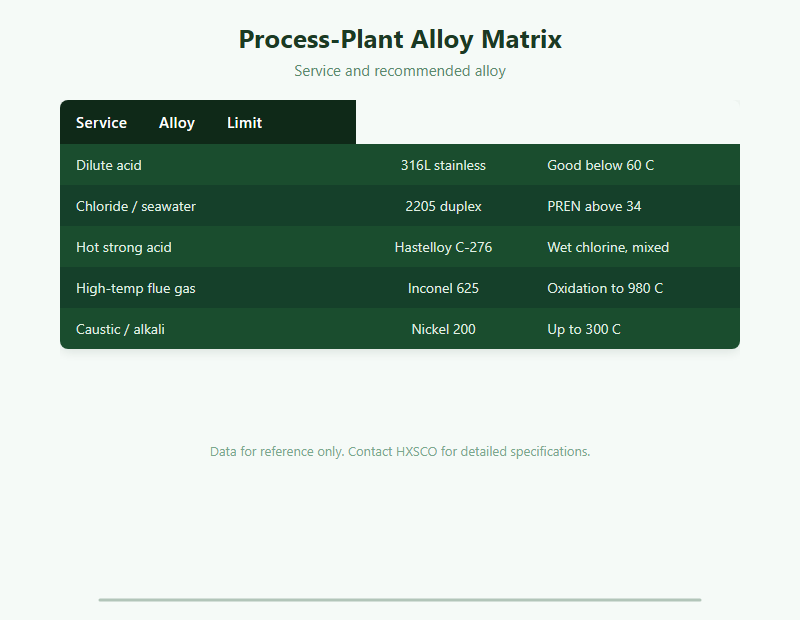
Start With the Environment
Corrosion rate depends on the exact acid, concentration, temperature and impurities, so the first step is to define the service, not the metal. Our 316 vs 316L, Stainless Grades Explained и Galvanic Corrosion Guide set the baseline.
Duplex for Chlorides
Where chloride or seawater is present, 2205 duplex stainless wins on pitting resistance and strength; the mechanism is in our Duplex Stainless Guide и Seawater Corrosion Guide.
Nickel Alloys for the Hard Jobs
Hastelloy C-276 and Inconel 625 take hot, strong and mixed-acid services that stainless cannot; compare them in our Hastelloy Guide, Inconel vs Hastelloy и Inconel Supplier pages.
Fabrication and Certification
High-alloy parts need careful welding and passivation, then full material certification. Our Passivation Guide и Mill Test Certificate Guide cover the shop and paper trail.
Specifying for Reliability
Buyers should specify the service envelope and the acceptance standard, then let the supplier propose the leanest qualified alloy. Our How to Choose a Metal Supplier helps frame the RFQ.
Get a Quote
Tell HXSCO your requirements and we will respond with a competitive quote and lead time.
Часто задаваемые вопросы
316L for many dilute acids below about 60 C; verify with the supplier.
2205 duplex stainless for its pitting resistance and strength.
Hot, strong or mixed acids where stainless fails, e.g. wet chlorine.
Inconel 625 for oxidation resistance to about 980 C.
We supply stainless, duplex and nickel alloys with mill certificate; send the service envelope.
Source Process-Plant Metal from HXSCO
HXSCO supplies corrosion-resistant stainless, duplex and nickel alloys for chemical duty. Describe your service and we will propose the alloy.