



Short answer: Case hardening adds carbon or nitrogen to the surface so parts get a hard wear layer over a tough core, done by gas or pack carburizing, carbonitriding or nitrocarburizing, arranged via our Surface Hardening Supplier page.
At a Glance
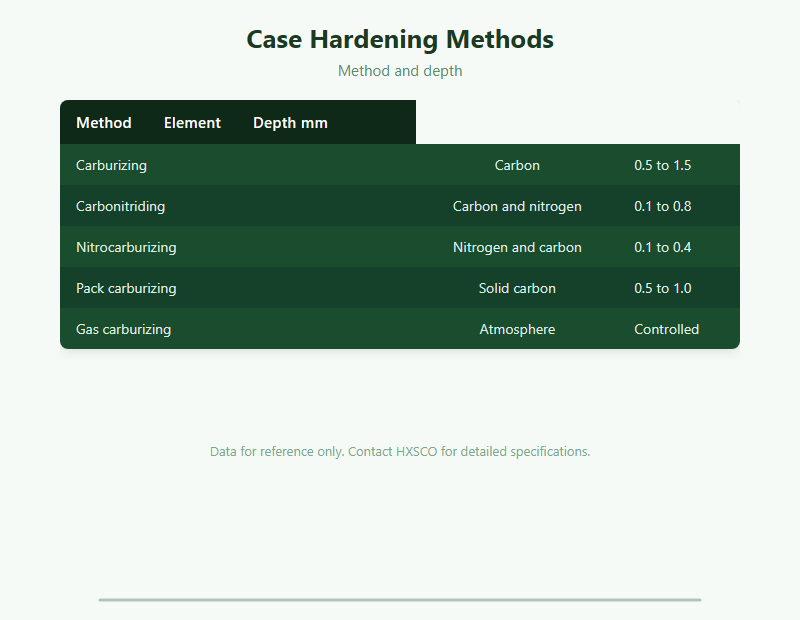
Why Case Harden
A hard case resists wear while a soft core resists shock, ideal for gears and pins, with base metal in our Carbon Steel Supplier and the broader route in our Surface Hardening Supplier page.
Carburizing and Carbonitriding
Gas carburizing gives controlled depth up to 1.5 mm and carbonitriding adds nitrogen for faster cycles, with the property basis in our Hardness and Tensile Guide.
Quality and Certification
Microhardness profiles confirm case depth; verify with our Quality Inspection Guide and documents per our Mill Test Certificate Guide.
Get a Quote
Tell HXSCO your requirements and we will respond with a competitive quote and lead time.
Часто задаваемые вопросы
Case keeps a tough core.
0.1 to 1.5 mm by method.
Gas for control, pack for small runs.
Carburizing or carbonitriding.
Yes – microhardness profile.
Get a Case Hardening Quote
HXSCO arranges carburizing and carbonitriding with case-depth reports. Send part type, material and depth for a quote.