


Short answer: TIG welding uses a non-consumable tungsten electrode for precise, clean welds on thin and exotic metals; MIG feeds a consumable wire for fast, high-deposition work on thicker sections — the choice is speed versus finish and control.
At a Glance
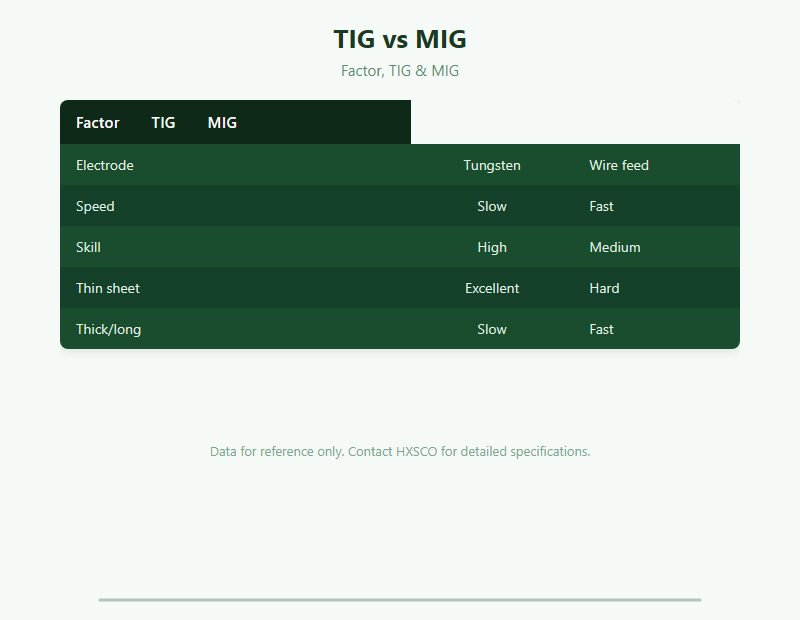
Process Differences
TIG holds a separate filler by hand and shields with argon; MIG pushes wire through the gun. Background in How To Weld Stainless Steel, Как сварить алюминий и How To Weld Carbon Steel; joint prep in Weld Edge Prep Guide.
Picking the Process
Use TIG for thin sheet, root passes and colour-critical work; use MIG for long seams and thick plate. Avoid mixing metals via Dissimilar Metal Welding Guide and control heat with Metal Heat Affected Zone Guide.
QA & Supply
Check beads and cracks by Weld Defects Guide и Metal Ndt Guide, limit distortion (Metal Welding Distortion Guide), and document consumables per Welding Consumables Guide и Mill Test Certificate Guide. HXSCO supplies weld-ready plate and tube.
Get a Quote
Tell HXSCO your requirements and we will respond with a competitive quote and lead time.
Часто задаваемые вопросы
TIG uses a fixed tungsten electrode with hand-fed filler; MIG feeds a consumable wire automatically.
TIG — its lower, controllable heat avoids burn-through on thin metal.
MIG — the continuous wire feed gives much higher deposition rates.
Yes — it needs both hands and precise heat control, so it takes more skill.
HXSCO supplies plate, sheet and tube prepared for TIG and MIG welding.
Source Weld-Ready Metal from HXSCO
HXSCO supplies plate, sheet and tube prepared for TIG and MIG welding with certificates. Send your alloy and quantity for a quote.