


Short answer: The heat-affected zone (HAZ) is the base metal beside a weld that was heated but not melted,so its microstructure and properties changed; narrower, well-controlled HAZs (from cleaner, lower-heat processes) preserve toughness and reduce cracking risk.
At a Glance
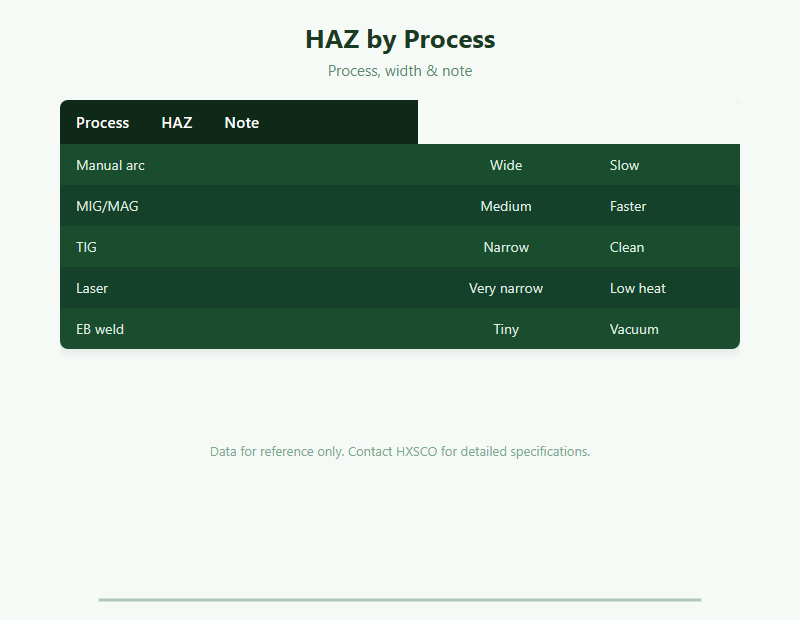
What the HAZ Is
The HAZ sits between the molten weld and unchanged base metal; it was heated into the transformation or recrystallisation range without melting. Its width grows with heat input, so How To Weld Carbon Steel 그리고 How To Weld Stainless Steel both watch it closely, and carbon sensitivity is in Steel Carbon Equivalent Guide. Defects nearby are covered in Weld Defects Guide.
Metallurgy of the HAZ
In steel it can harden (martensite) or soften (over-tempered); grain growth and brittle phases appear with too much heat. Context is Grain Structure Metals, Stress Relieving Vs Annealing 그리고 Nitriding Vs Carburizing; for stainless see Martensitic Vs Austenitic Stainless 그리고 Metal Brittle Fracture Guide.
Controlling the HAZ
Use TIG/laser/EB for narrow HAZ, control preheat and interpass, and choose the right filler via Dissimilar Metal Welding Guide. Verify with Metal Ndt Guide 그리고 Metal Hardness Testing Methods, and certificate per Mill Test Certificate Guide; tempering guidance is in Quenching Media Guide.
Get a Quote
Tell HXSCO your requirements and we will respond with a competitive quote and lead time.
자주 묻는 질문
The base metal adjacent to the weld that was heated enough to change microstructure but did not melt; its properties differ from both weld and parent metal.
Less heated material means less hardness variation, less distortion and lower risk of cracking or brittle phases.
Laser and electron-beam welding give very narrow HAZs because of their low total heat input; TIG is narrower than manual arc or MIG.
By hardness traverse across the joint, microstructure examination and NDT such as UT/MT/PT per the procedure and standard.
HXSCO supplies steels and alloys with controlled chemistry (CEV) and certified properties to support sound, low-risk welding.
Source Weld-Friendly Metal from HXSCO
HXSCO supplies steels and alloys with controlled CEV and certified properties for low-risk welding. Send your grade, standard and quantity for a quote.