


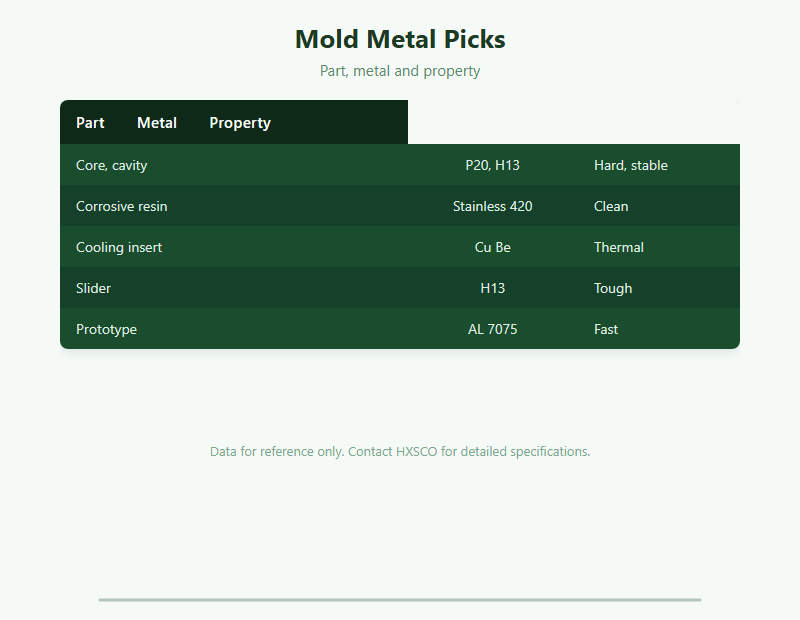
Short answer: Injection moulds use pre-hardened P20 and hardened H13 for cores and cavities, stainless 420 for corrosive resins, beryllium copper for fast-cooling inserts and aluminium for prototypes, chosen for hardness, polishability, dimensional stability and thermal performance.
At a Glance
What a Mold Needs
Hardness, polish and stability keep the part dimension, with the basis in our Hardness Comparison 그리고 Yield and Tensile Guide; heat duty in our Heat Treatment Guide.
Cores, Cavities and Steel
P20 and H13 are the workhorses, with tool steel detail in our Tool Steel Supplier and machining in our Machining Guide; finish in our Surface Roughness Guide.
Cooling and Corrosive Resin
Beryllium copper inserts pull heat fast and stainless 420 resists corrosive resin, with alloy data in our Nickel Alloy Grades Guide and copper in our Copper Supplier.
Sourcing and Spec
Mould makers confirm hardness and certification via our Mill Test Certificate Guide; packing is in our Export Packing Guide.
Get a Quote
Tell HXSCO your requirements and we will respond with a competitive quote and lead time.
자주 묻는 질문
Pre-hardened P20 for general use and hardened H13 for high-volume hot molds.
Stainless 420 resists corrosive resins and keeps a clean cavity.
Fast-cooling inserts that cut cycle time at hot spots.
Aluminium 7075 is fast and cheap for prototype and low-run molds.
Through heat treatment and verified by certificate and hardness test.
Source Mold Metal with HXSCO
HXSCO supplies P20, H13, stainless 420, beryllium copper and prototype aluminium for injection moulds. Send your steel grade and hardness for a quote.