


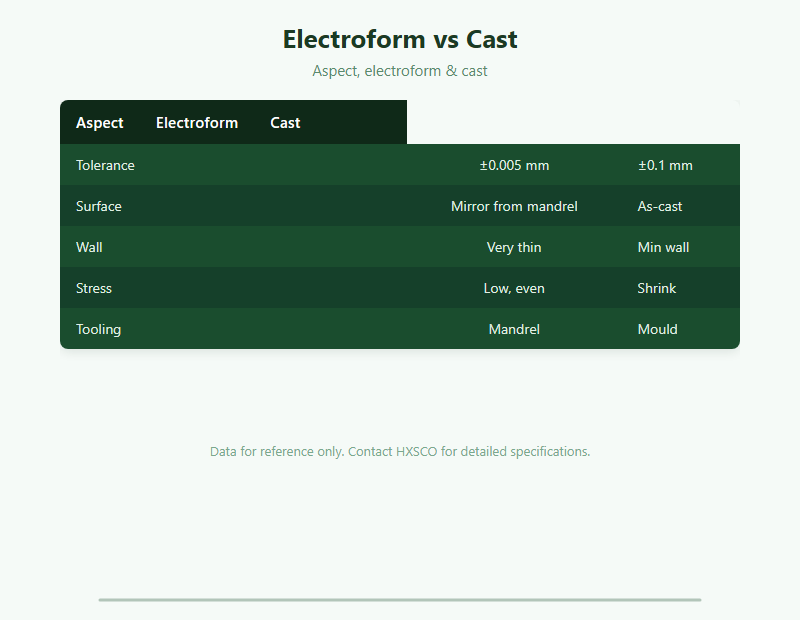
Short answer: Electroforming grows a precise metal part by electrodepositing metal onto a shaped mandrel, then separating it — delivering mirror surfaces, micron tolerances and ultra-thin walls that casting and machining cannot match.
At a Glance
The Process
Metal ions plate onto a conductive mandrel until the shell reaches the needed thickness, then the part is stripped off. It shares electrochemistry with Anodizing Vs Electroplating 그리고 Metal Surface Treatment Guide, and avoids the distortion of 알루미늄 용접 방법. Compared with Casting Supplier it wins on accuracy and surface.
Where Electroforming Wins
Aerospace waveguides, sieves, injection moulds, meshes and optical parts need tight tolerances and fine features; relate to Metal Tolerances Fits Guide, Surface Roughness Ra Guide 그리고 Metal Burr Deburring Guide. Nickel and copper are typical — see Nickel Supplier 그리고 Copper Alloys Guide.
Design, QA & Supply
Plan draft-free mandrels and uniform current; verify dimensions and deposit with Metal Ndt Guide 그리고 Mill Test Certificate Guide. HXSCO can advise on electroformed versus Cnc Machining Supplier for your part.
Get a Quote
Tell HXSCO your requirements and we will respond with a competitive quote and lead time.
자주 묻는 질문
Building a precise metal part by electrodepositing metal onto a mandrel and then separating the finished shell.
Waveguides, fine meshes, injection moulds, sieves and optical/aerospace parts needing micron accuracy.
Tolerances near ±0.005 mm with mirror surfaces reproduced from the mandrel.
Nickel and copper are most common; nickel-cobalt and gold are used for special parts.
For tight tolerance, thin walls and fine surface detail, yes; casting is faster for thick, simple parts.
Source Precision Metal from HXSCO
HXSCO advises on electroformed versus machined precision parts and supplies nickel/copper stock for the process. Send your drawing and quantity for a quote.