


Short answer: Crevice corrosion is localised attack under shielded, oxygen-starved gaps — flange faces, gaskets, threaded joints and deposits — where stainless steel’s passive film cannot self-repair; it is beaten by higher-PREN grades such as 316L, duplex 2205 or super-austenitic alloys, good drainage and proper passivation, not by thicker material.
At a Glance
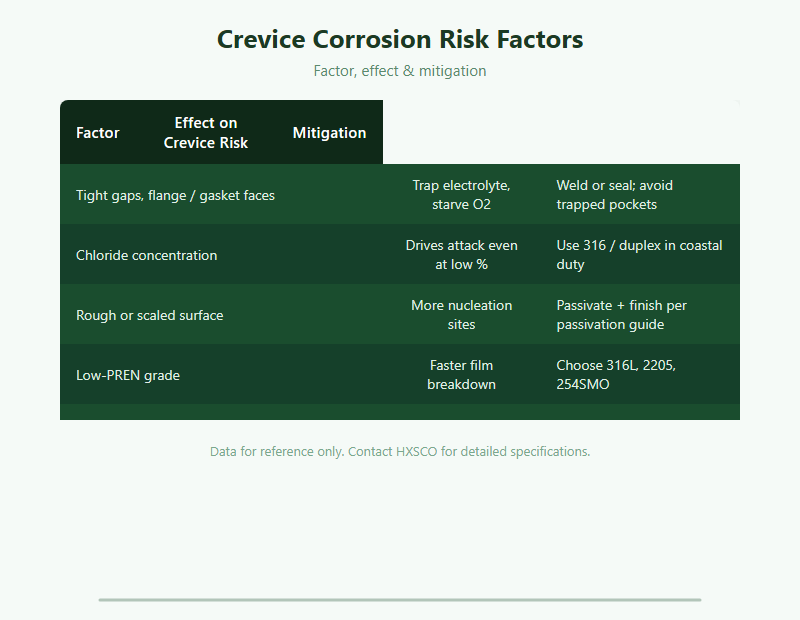
Why Crevices Corrode First
Stainless steel resists corrosion because a chromium-rich oxide film heals itself in the presence of oxygen. A crevice — under a bolt head, gasket, lap joint, deposit or tube sheet — traps a thin film of liquid and the oxygen inside is consumed faster than it can diffuse back in. Once the film breaks down locally, metal ions dissolve, chloride migrates in to balance the charge, and an acidic, aggressive cell forms that eats into the parent metal. It is the same family of failure as Pitting Corrosion Stainless Steel, but triggered by geometry rather than a surface flaw, and it is far more common in real assemblies than open-surface pitting. The grade choice that governs resistance is explained in 스테인리스 스틸 등급 설명, and the surface condition that delays initiation is set by Passivation Vs Pickling.
Which Grades Resist Crevice Attack
Resistance tracks PREN (pitting resistance equivalent number), which rises with chromium, molybdenum and nitrogen. Type 304 (PREN ~18) is vulnerable in any chloride environment; Stainless Steel 316 Properties (PREN ~25 with 2-3% molybdenum) handles most mild and indoor chloride service; Duplex Stainless Steel Guide grades such as 2205 (PREN ~35) and super-austenitics push well past 40 for seawater and process brine. Where crevice attack must be ruled out entirely, titanium is effectively immune — the comparison is in Titanium Vs Steel. Specifying the right grade up front is cheaper than retrofitting a failed joint, and it should be matched to the confirmed chloride level, not a generic “stainless” assumption.
Design and Mitigation
Prefer welded and continuously sealed joints over bolted assemblies where crevices cannot be eliminated; when gaskets are unavoidable, use non-absorbent, flush designs and full circumferential welds. Keep surfaces smooth and passivated, and avoid fretting and embedded iron from carbon-steel contact (plan mixed-metal joints with Galvanic Corrosion Guide). Operate with flow and drainage so liquid does not stagnate, and build a cleaning routine into the duty cycle — practical steps are in How To Clean Stainless Steel and the surface options in Stainless Steel Surface Finishes. Where crevices are unavoidable and the environment is severe, move to 2205 or a higher alloy rather than accepting recurrent repairs.
Get a Quote
Tell HXSCO your requirements and we will respond with a competitive quote and lead time.
자주 묻는 질문
It is localised corrosion under shielded, oxygen-starved gaps such as flange faces, gaskets, threads and deposits, where the passive film cannot self-repair and an aggressive acidic cell forms inside the crevice.
Higher-PREN grades resist best: 316L for mild chloride service, duplex 2205 for seawater and brine, and super-austenitic or super-duplex alloys for the most severe duty; titanium is effectively immune.
Yes. With a PREN around 18, 304 is vulnerable to crevice attack wherever chlorides are present, even at low concentration, which is why 316 or duplex is preferred for outdoor and marine joints.
Use welded or sealed joints instead of bolted ones, specify higher-PREN grades for chloride duty, keep surfaces passivated and smooth, ensure drainage and flow, and avoid embedded iron and stagnant liquid.
Specify Crevice-Resistant Stainless from HXSCO
HXSCO supplies 304, 316L, 2205 duplex and higher alloys with PREN-matched grades and mill certificates. Send your chloride level and joint design for a quote.