


Short answer: Hardness tracks tensile strength because both depend on the metal’s resistance to deformation — so you can estimate ultimate tensile strength (UTS) from a Brinell or Rockwell reading using standard conversion tables, handy when only a quick hardness test is practical.
At a Glance
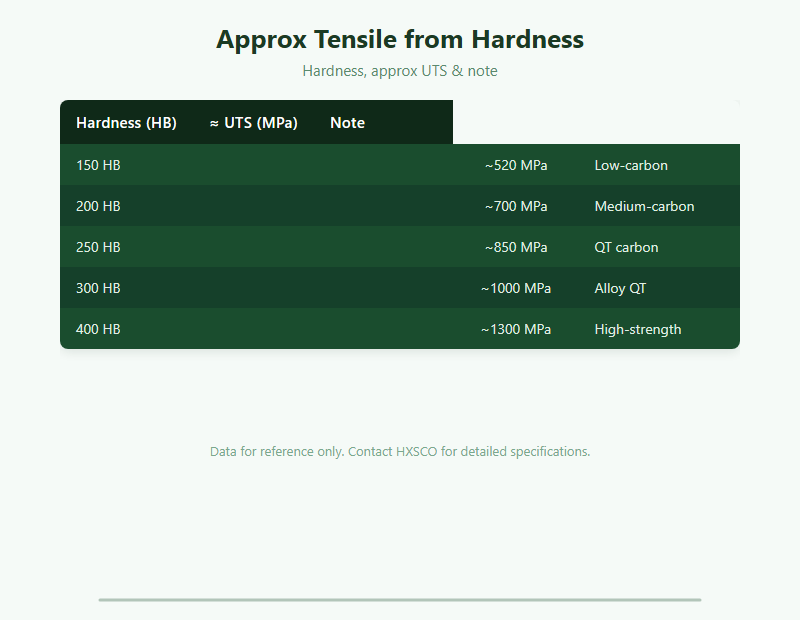
Why Hardness Tracks Strength
Hardness is resistance to local indentation; tensile strength is resistance to stretching — both measure the same underlying bond and dislocation behaviour, so they correlate. The exact relation is tabulated in Hardness Conversion Chart and measured by Metal Hardness Testing Methods. It lets shops estimate UTS from a fast hardness check instead of a full tensile pull.
Converting Hardness to UTS
For steel, UTS (MPa) ≈ 3.4 × Brinell hardness (HB) in the mid range, with small offsets by carbon level; conversion charts also span Rockwell and Vickers. This estimate supports grade selection with Steel Grade Equivalent Chart and pairs with the true properties in Yield Strength Vs Tensile Strength. Accuracy is best for normalized or quenched-and-tempered carbon and alloy steel.
Cautions & Use
The correlation weakens for work-hardened, heavily tempered or non-ferrous metals, and hardness alone says nothing about ductility or toughness. Use it for sorting and screening, then confirm with a tensile test for design — machining response also follows hardness via Metal Machinability Guide.
Get a Quote
Tell HXSCO your requirements and we will respond with a competitive quote and lead time.
Pertanyaan yang Sering Diajukan
Yes. For steel, UTS in MPa is roughly 3.4 times the Brinell hardness (HB); standard conversion tables also cover Rockwell and Vickers.
Both measure resistance to plastic deformation from the same underlying crystal behaviour, so harder metals are generally stronger in tension.
Good for normalized or QT carbon and alloy steel; less reliable for work-hardened, greatly tempered or non-ferrous metals, and it does not predict ductility.
Around 300 HB (Brinell) or about 32 HRC for quenched-and-tempered alloy steel, per the standard conversion charts.
Yes. HXSCO supplies carbon and alloy steel with hardness and tensile certificates on request; tell us your grade and condition.
Source Certified Steel from HXSCO
HXSCO supplies carbon and alloy steel with hardness and tensile certificates on request. Send your grade, condition and quantity for a quote.