


Short answer: PPGI (Pre-Painted Galvanized Iron) uses a zinc-coated steel substrate with polyester/SMP/PVDF paint. PPGL (Pre-Painted Galvalume) uses a Zn-Al (55% Al, 43.5% Zn, 1.5% Si) coated substrate with superior edge protection and heat reflectivity. Choose PPGL for roofing in corrosive/coastal areas; PPGI for general wall panels and indoor applications.
At a Glance
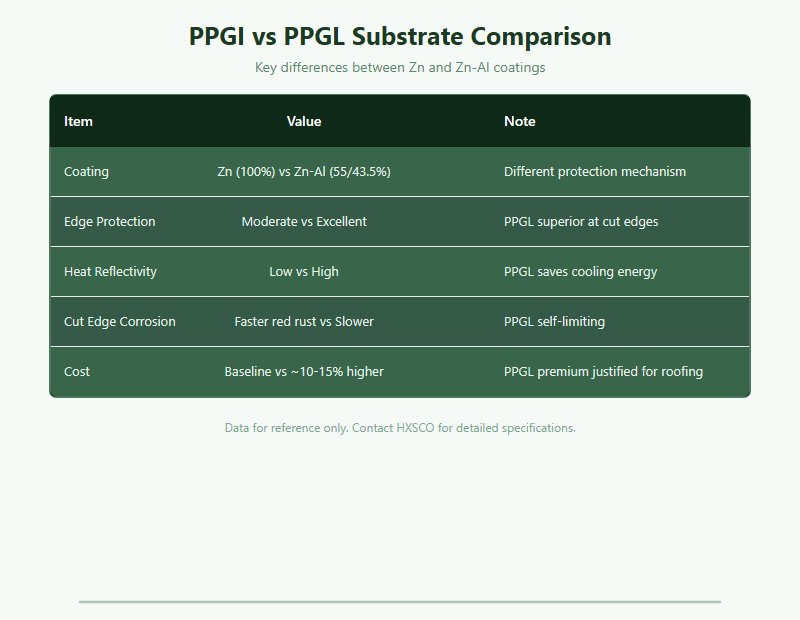
Substrate Difference: Zinc vs Galvalume
| Karakteristik | PPGI (Zn) | PPGL (Zn-Al) |
|---|---|---|
| Coating composition | 100% Zn (60–275 g/m²) | 55% Al, 43.5% Zn, 1.5% Si |
| Edge protection | Moderate (sacrificial) | Excellent (barrier + sacrificial) |
| Heat reflectivity | Rendah | High (saves cooling energy) |
| Cut edge corrosion | Faster red rust | Slower, self-limiting |
| Biaya | Lebih rendah | ~10–15% higher |
Paint Systems Compared
Both PPGI and PPGL share the same topcoat options:
- Polyester (PE): Most economical, 5–10 year life, wide color range. General construction.
- Silicon Modified Polyester (SMP): Better hardness and fade resistance, 10–15 year life.
- PVDF (Polyvinylidene Fluoride): Premium, 20–30 year life, best UV/fade resistance. Coastal and high-end architectural. See coated steel supplier page.
The substrate choice (Zn vs Zn-Al) determines corrosion performance; the paint system determines color durability and aesthetics.
Application Selection Guide
Choose PPGI for: Interior wall panels, partition walls, appliances (refrigerator doors, washing machine panels), furniture, garage doors, non-critical exterior cladding in low-corrosion environments.
Choose PPGL for: Metal roofing (especially in industrial/coastal areas), agricultural buildings, warehouses, facades in humid climates, solar panel mounting structures, anywhere edge corrosion from cutting/drilling is a concern.
Rule of thumb: If the application involves roofing, frequent rain exposure, or proximity to salt/industrial pollutants → PPGL. If it’s primarily walls, indoors, or budget-driven → PPGI.
Specifications & Standards
PPGI/PPGL products commonly reference: ASTM A755 (steel sheet), EN 10169 (continuously coated), JIS G3312 (precoated). Coating thickness: total (metal + paint) typically 15–35 μm front, 5–15 μm back. Widths: 600–1250 mm common; thicknesses: 0.18–1.5 mm.
Get a Quote
Tell HXSCO your requirements and we will respond with a competitive quote and lead time.
Pertanyaan yang Sering Diajukan
PPGL is strongly preferred for roofing because the Zn-Al coating provides far superior edge protection (critical where sheets are cut) and higher heat reflectivity reduces cooling costs.
Yes — both are designed for roll forming, bending, and profiling. Minimum bend radius depends on paint system and thickness; consult the manufacturer’s data sheet. Excessive strain can cause micro-cracking in the paint film.
Hundreds of RAL colors are available. Common standards include RAL 9002 (white-grey), RAL 9010 (white), RAL 3009 (red), RAL 5010 (blue), RAL 6002 (green), RAL 7035 (light grey), plus wood-grain and printed patterns.
With PE paint: 5–10 years. SMP: 10–15 years. PVDF: 20–30 years. Service life depends on environment, installation quality, and maintenance. Coastal areas reduce all estimates by 30–50%.
Yes — HXSCO stocks PPGI and PPGL in multiple paint systems (PE, SMP, PVDF), thicknesses, and colors. We can also source custom color-matched production runs.
Get Your Pre-Painted Steel Quote
Tell us PPGI or PPGL, paint system, color (RAL), thickness, width, quantity, and destination port. HXSCO quotes within 24 hours with delivery options.