


Short answer: Substitution swaps one alloy for another to cut cost or lift performance, but only safely when the replacement meets the real service demands; the leanest qualified alloy is usually the right target, not the most familiar one.
At a Glance
Why Substitute at All
Substitution is driven by cost, supply or performance, and the two materials are compared head-to-head in our Steel vs Aluminium dan Copper vs Aluminium Wire guides.
Cost-Down Swaps
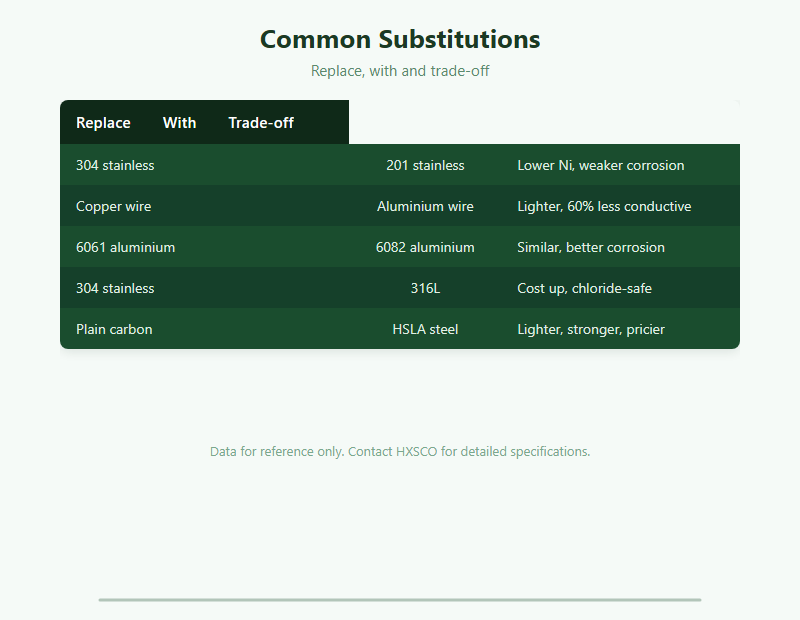
201 can replace 304 where corrosion is mild, 6082 can stand in for 6061, and aluminium wire can replace copper where weight matters more than conductivity; details in 304 vs 201, 3003 vs 5052 dan Titanium vs Steel.
Performance Upgrades
Moving 304 to 316L adds chloride resistance, and nickel alloys upgrade the hardest services; compare in 316 vs 316L dan Inconel vs Hastelloy.
Recyclability and Supply
Substituted alloys should stay recyclable and available; our Metal Recycling Guide covers end-of-life handling.
Specifying a Substitution Safely
Validate the replacement against the actual environment and standard before changing the drawing; our How to Choose a Metal Supplier dan Mill Test Certificate Guide help document the change.
Get a Quote
Tell HXSCO your requirements and we will respond with a competitive quote and lead time.
Pertanyaan yang Sering Diajukan
In mild, indoor duty yes, but 201 has lower nickel and weaker corrosion resistance.
For weight-critical runs yes, but it is about 40 percent less conductive and needs proper terminations.
Where chlorides or seawater are present, to avoid pitting.
Keep alloys recyclable; our recycling guide covers sorting.
Validate against the real environment and standard, then document the change with mill certs.
Get Substitution Advice from HXSCO
HXSCO helps you substitute alloys for cost or performance without compromising the design. Send your current spec for a recommendation.