


Short answer: Grain flow is the directional alignment of a metal’s fibrous structure produced by working; forged parts keep continuous flow lines that follow the contour and resist fatigue, while machining cuts across them and casting leaves them random — which is why critical load paths are forged.
At a Glance
What Grain Flow Is
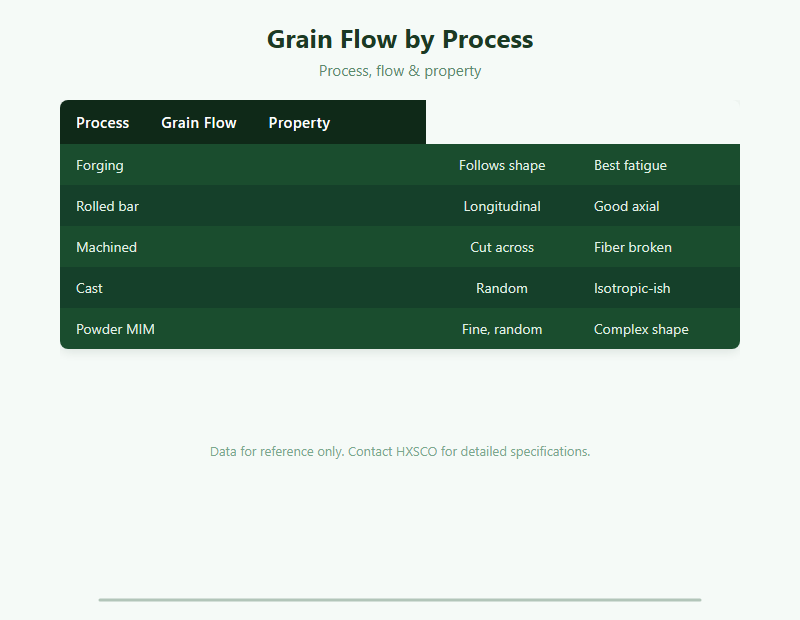
Ingot solidification is random, but hot working stretches the inclusions and crystallographic texture into fibres that run along the deformation direction. Forging bends those fibres to follow the part outline, so a crank or link carries unbroken flow through its corners — the microstructural basis for the strength in Forging Supplier parts and the comparison in Forging Vs Casting. The underlying structure is in Grain Structure Metals, and fatigue resistance is why it matters per Metal Fatigue Endurance Limit.
Flow in Forming
Rolled bar has longitudinal flow good in one axis; machining removes metal and cuts fibre ends at every surface, briefly weakening fatigue start points unless the stock grain was oriented well. Casting (Casting Supplier) and MIM give near-random fine grain suited to complex shapes rather than peak strength. Where machining dominates, plan with Metal Stamping Vs Machining dan Cnc Machining Supplier, and expect the cutting behaviour in Metal Machinability Guide.
Designing With Flow
Orient grain flow along the principal stress, keep critical sections forged rather than machined from bar, and verify with Metal Ndt Guide and etch inspection. Avoid notches across the flow, and relieve residual stress per Stress Relieving Vs Annealing before the part sees cyclic load — the strength basis is Yield Strength Vs Tensile Strength.
Get a Quote
Tell HXSCO your requirements and we will respond with a competitive quote and lead time.
Pertanyaan yang Sering Diajukan
Grain flow is the directional arrangement of a metal’s fibrous microstructure produced by hot working; the fibres align along the direction of deformation.
Forging bends the flow lines to follow the part contour, so fibres are continuous through corners and load paths, giving better fatigue and impact strength than machined bar.
Yes. Machining cuts across the fibres and exposes their ends at the surface, which can create fatigue-initiation sites; orienting stock grain along stress helps.
Largely yes — casting solidifies with a near-random, equiaxed or columnar structure rather than directional fibre, which is why forgings are preferred for highly stressed parts.
Yes. HXSCO supplies open-die, closed-die and rolled-ring forgings with grain-flow and ultrasonic inspection on request.
Source Forged Parts from HXSCO
HXSCO supplies open-die, closed-die and rolled-ring forgings with controlled grain flow and UT inspection. Send your forging drawing and quantity for a quote.