



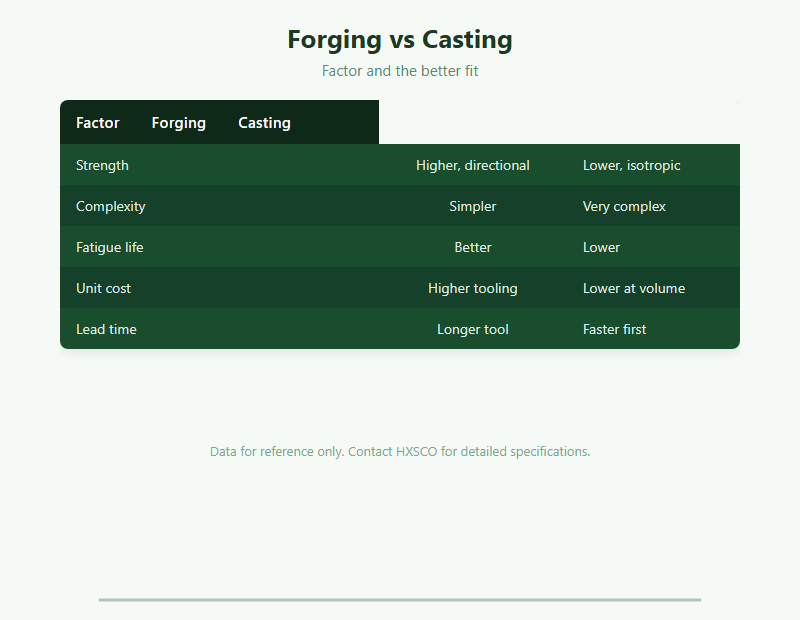
Short answer: Forging wins for loaded, fatigue-critical parts because the grain flow follows the shape and raises strength, while casting wins for complex, low-stress shapes and faster first articles; alloy and volume decide the call.
At a Glance
Strength and Grain Flow
Forging aligns the grain with the load path, raising strength and fatigue life; the fatigue case is in our Fatigue Guide and the data in our Perbandingan Kekuatan, with grades in our Types and Grades of Steel.
Shape Complexity and Cost
Casting reaches shapes forging cannot and often costs less at volume; the steel families are in our Stainless Steel Supplier dan Carbon Steel Supplier, and heat treatment that follows is in our Heat Treatment Guide.
Alloy and Process Fit
Steel and titanium forge well; some alloys favour casting; the titanium angle is in our Titanium Supplier and the surfacing in our Surface Treatment Guide.
Making the Call
Pick forging for safety-critical loaded parts and casting for complex, low-stress bodies; weigh tooling, volume and lead time against the service duty before committing.
Get a Quote
Tell HXSCO your requirements and we will respond with a competitive quote and lead time.
Pertanyaan yang Sering Diajukan
Forging — the grain flow follows the shape and raises strength.
For complex shapes and lower cost at higher volume.
Steel and titanium forge well; some favour casting.
Tooling costs more, but loaded parts earn it back in life.
Match the process to load, shape, volume and lead time.
Choose Forging or Casting with HXSCO
HXSCO advises forging vs casting and supplies the right grade either way. Send the part and duty and we will recommend a route and quote.