



Short answer: Induction hardening selectively heats and quenches the surface of shafts, gears and cams for fast, low-distortion wear resistance, arranged via our Surface Hardening Supplier page and compared with carburizing in our Case Hardening Guide.
At a Glance
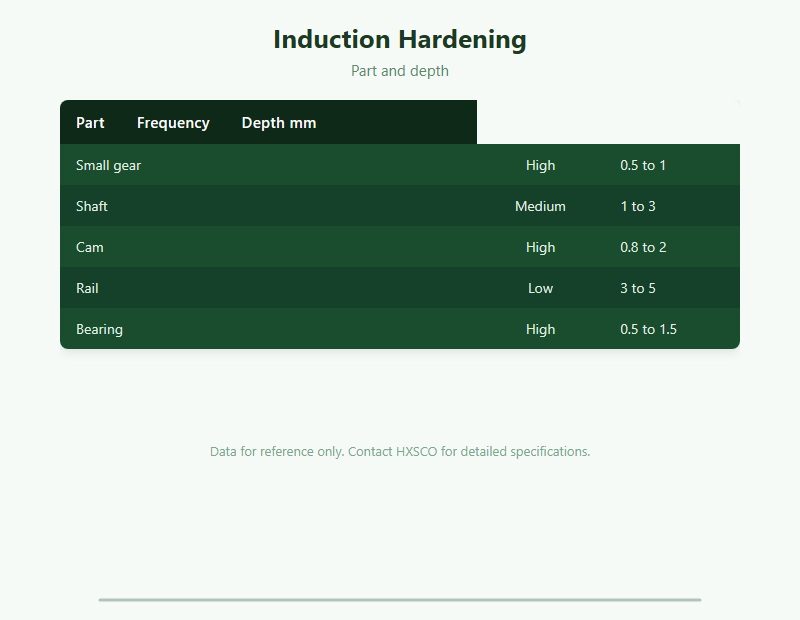
How Induction Hardening Works
A high-frequency coil heats a thin surface layer that is quenched in place, leaving a tough core, with base stock in our Carbon Steel Supplier and the property basis in our Hardness and Tensile Guide.
Frequency and Depth
Higher frequency gives a shallower case; shafts use medium frequency for a 1 to 3 mm case and small gears use high frequency, with the route in our Surface Hardening Supplier page.
Quality and Certification
Pattern and depth are checked per part; verify with our Quality Inspection Guide and documents per our Mill Test Certificate Guide.
Get a Quote
Tell HXSCO your requirements and we will respond with a competitive quote and lead time.
Pertanyaan yang Sering Diajukan
Induction is cleaner and more repeatable.
By frequency and power.
Yes – medium frequency.
Yes – only the surface hardens.
Yes – depth and hardness map.
Get an Induction Hardening Quote
HXSCO arranges induction hardening for shafts, gears and cams with pattern reports. Send part geometry and depth for a quote.