


Two aluminum alloys dominate industrial and aerospace purchasing: 6061 dan 7075. The right choice depends on whether your project needs weldability and corrosion resistance, or maximum strength and fatigue resistance. Below is a practical comparison guide for buyers, engineers, and procurement teams.

What is 6061 Aluminum?
6061 aluminium is one of the most versatile alloys on the market. It is a magnesium-silicon alloy (Al-Mg-Si) that responds well to heat treatment. The most common variant is 6061-T6, which has been solution heat treated and artificially aged.
Key characteristics include:
- Good strength-to-weight ratio for general applications
- Excellent weldability and corrosion resistance
- Strong machinability and anodizing response
- Widely available and cost-effective
What is 7075 Aluminum?
7075 aluminium is a high-strength alloy whose primary alloying element is zinc (Al-Zn-Mg-Cu). The 7075-T6 temper offers one of the highest strength levels of any aluminum alloy, comparable to some structural steels.
Key characteristics include:
- Very high tensile and yield strength
- Ketahanan lelah yang sangat baik
- Lower corrosion resistance than 6061 unless clad
- Higher cost and more difficult to weld
6061 vs 7075: Key Differences
Kekuatan
7075-T6 is roughly 80–90% stronger than 6061-T6. If your part is load-critical, 7075 is usually the better choice.
Weight
7075 is slightly denser than 6061 (2.81 g/cm³ vs 2.70 g/cm³). For a given volume, 7075 is marginally heavier, though its higher strength often allows thinner sections.
Ketahanan Korosi
6061 generally offers better corrosion resistance, especially in wet or marine environments. 7075 is more susceptible to corrosion and is often used in clad form (Alclad 7075) when corrosion is a concern.
Kemampuan mesin
6061 machines cleanly and is considered excellent for CNC milling, turning, and drilling. 7075 is also machinable but harder on tooling and produces more heat.
Kemampuan las
6061 is far more weldable than 7075. 7075 is generally not recommended for fusion welding because it tends to crack and loses strength in the heat-affected zone.
Biaya
7075 typically costs more than 6061 due to higher alloy content and more stringent processing. For cost-sensitive applications that do not need maximum strength, 6061 is the economical choice.
6061 vs 7075 Comparison Table
Use this side-by-side reference to compare typical values for 6061-T6 and 7075-T6.
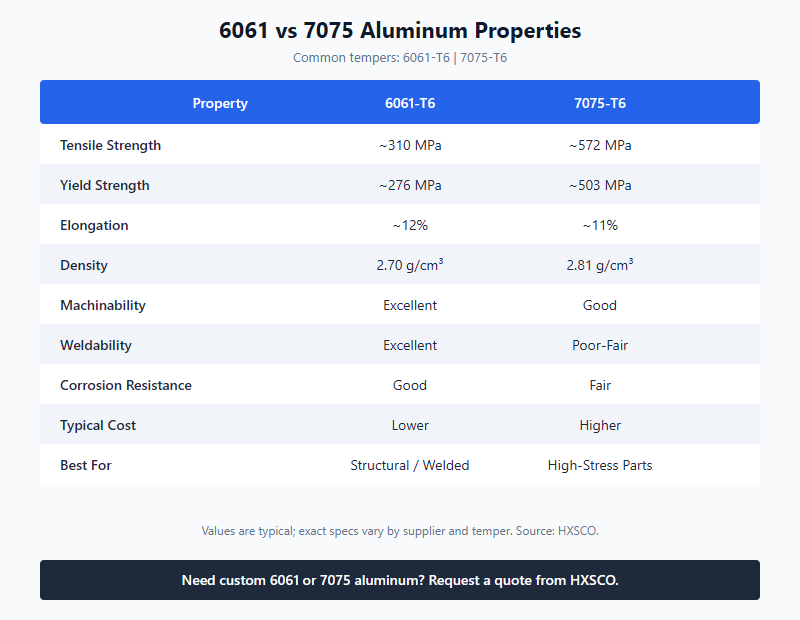
| Properti | 6061-T6 | 7075-T6 |
|---|---|---|
| Kekuatan Tarik | ~310 MPa | ~572 MPa |
| Kekuatan Hasil | ~276 MPa | ~503 MPa |
| Perpanjangan | ~12% | ~11% |
| Kepadatan | 2,70 g/cm³ | 2,81 g/cm³ |
| Kemampuan mesin | Luar biasa | Bagus |
| Kemampuan las | Luar biasa | Poor-Fair |
| Ketahanan Korosi | Bagus | Fair |
| Typical Cost | Lebih rendah | Higher |
When to Choose 6061 Aluminum
Choose 6061 when your project requires:
- Good corrosion resistance in outdoor or marine environments
- Welded assemblies and structural frames
- Cost-effective machining and finishing
- Anodized decorative or protective finishes
When to Choose 7075 Aluminum
Choose 7075 when your project requires:
- Maximum strength-to-weight ratio
- High fatigue resistance (aircraft, high-performance cycling, racing)
- Parts subject to high loads and stresses
- Budget allows premium alloy cost
Aplikasi Umum
| 6061 Common Uses | 7075 Common Uses |
|---|---|
| Automotive trim and frames | Aircraft structural components |
| Marine fittings and boat parts | High-performance bicycle parts |
| Construction and architectural extrusions | Rock climbing and sporting gear |
| Electronics housings and heat sinks | Molds and tooling plates |
| General industrial fabrication | Defense and aerospace components |
Get Expert Help Choosing Your Alloy
Still unsure whether 6061 or 7075 is right for your application? Browse our aluminum products atau contact the HXSCO team. With about 20 years of metal supply experience, we can recommend the right alloy, temper, size, and finish for your project.
Request a 6061/7075 Aluminum Quote
Pertanyaan Umum: Aluminium 6061 vs 7075
Yes. In the T6 temper, 7075 has roughly 80–90% higher tensile and yield strength than 6061. It is one of the strongest aluminum alloys available.
6061 is slightly less dense (2.70 g/cm³) than 7075 (2.81 g/cm³). For the same volume, 6061 is marginally lighter, although 7075’s higher strength can allow thinner sections.
7075 is generally not recommended for fusion welding. It is prone to cracking and loses strength in the heat-affected zone. 6061 is the better choice for welded assemblies.
6061 offers good corrosion resistance, but for prolonged saltwater exposure, 5052 or 5083 marine-grade aluminum are typically better choices. 6061 is still commonly used for marine fittings and structural parts.
7075 contains more costly alloying elements (especially zinc and copper) and requires more controlled processing. Its superior strength also makes it a premium material.