


Short answer: Pipe is sized by Nominal Pipe Size and schedule for moving fluids, with a fixed outside diameter and a wall that sets pressure rating; tube is sized by exact outside diameter and wall for structural and mechanical use where tight dimensional tolerance matters more than flow. The right choice follows the job: flow uses pipe, fit and structure use tube.
At a Glance
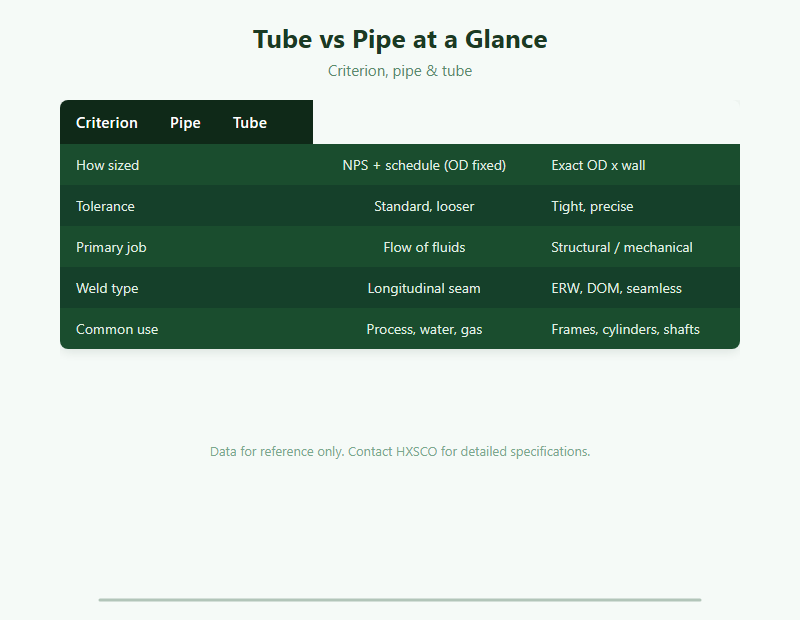
How They Are Specified Differently
Pipe carries a Nominal Pipe Size (NPS) and a schedule; for a given NPS the outside diameter is fixed and the wall sets the pressure rating, so you select it for flow and pressure — the products live in our Steel Pipe Supplier и Steel Tube Supplier programmes. Tube is defined by exact outside diameter and wall thickness (often in millimetres or fractional inches) with much tighter tolerances, because it is bought for fit and structure rather than flow. Measuring and confirming an unknown pipe size is covered in How To Measure Steel Pipe Size, and the manufacturing routes behind both are the subject of Erw Vs Seamless Pipe.
Manufacturing Overlap
Both can be welded (ERW), drawn or seamless, so the seam type is not what separates them — the specification and tolerance are. Pipe is produced to API, ASTM A53/A106 or EN standards for pressure integrity; tube is produced to ASTM A513/A519 or EN 10305 for mechanical properties and dimensional precision. Grade and test acceptance appear on the certificate described in Mill Test Certificate Guide, and stainless versions are handled through our Stainless Steel Pipe Supplier line. Do not substitute one for the other just because the diameters look similar — the tolerance and test basis differ.
Choosing for Your Application
Specify pipe for any closed-loop or open fluid system — water, steam, gas, oil, chemicals — where pressure rating and a standard flange fit matter, and pick the coating or alloy per Black Steel Vs Galvanized Pipe и How To Prevent Metal Rust. Specify tube for roll cages, machine frames, hydraulic cylinders, shafts, bearings and instrumentation where roundness, straightness and wall consistency drive performance. If you are unsure which your drawing calls for, send the standard and dimensioning and HXSCO will route it to the correct product line and grade.
Get a Quote
Tell HXSCO your requirements and we will respond with a competitive quote and lead time.
Часто задаваемые вопросы
Pipe is sized by NPS and schedule for fluid flow with a fixed outside diameter and a pressure-rated wall; tube is sized by exact OD and wall for mechanical and structural use with tight tolerances.
Neither is inherently stronger; they are made to different standards. Tube offers tighter dimensional control for structural fit, while pipe is built and tested for pressure containment.
Generally no — plumbing and process lines use pipe sized by NPS and schedule for predictable flow and flange compatibility; tube is for structural and mechanical applications.
Yes. HXSCO supplies steel pipe for fluid service and precision steel tube for structural and mechanical use, in carbon, alloy and stainless, with the relevant standards and certificates.
Order Steel Tube or Pipe from HXSCO
HXSCO supplies steel pipe for fluid service and precision tube for structural use, in carbon, alloy and stainless with the right standard and certificate. Send your specification for a quote.