



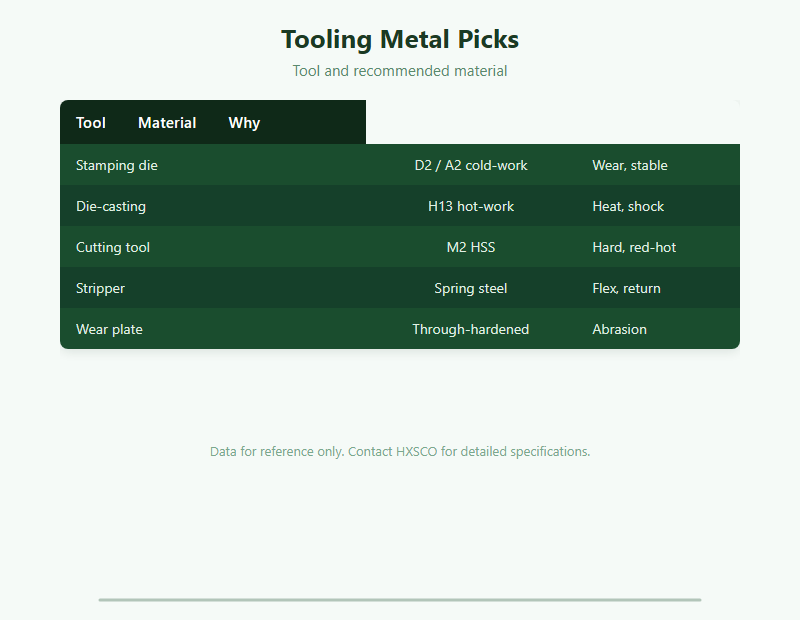
Short answer: Tooling and dies rely on cold-work tool steel for stamping, hot-work tool steel for die casting, high-speed steel for cutting edges and spring steel for strippers, with grade chosen for hardness, toughness and dimensional stability under load and heat.
At a Glance
Cold and Hot Work Steels
Stamping and forming dies use cold-work grades like D2 and A2, while die-casting and forging dies use hot-work H13; the full family is in our Tool Steel Types Guide and the strength data in our Сравнение прочности.
Cutting and Edge Tools
Drills, mills and blades need high-speed steel and carbides that hold hardness hot; the heat treatment that locks in that hardness is in our Heat Treatment Guide, with a broader grade view in our Types and Grades of Steel.
Springs, Strippers and Return
Strippers and return springs use spring steel for flex life; the grades are in our Spring Steel Guide, and fatigue limits are covered in our Fatigue Guide.
Stability and Finish
Dies must hold size and finish under load, so stable, clean steels and good surfacing matter; the surfacing side is in our Surface Treatment Guide and corrosion care in our Corrosion Resistance Guide, with stainless options in our Stainless Steel Supplier.
Get a Quote
Tell HXSCO your requirements and we will respond with a competitive quote and lead time.
Часто задаваемые вопросы
Cold-work D2 or A2 for wear resistance and dimensional stability.
Hot-work H13 for heat and thermal-shock resistance.
It stays hard at the red heat of cutting edges.
Strippers and return springs need flex life.
Critical — it sets the hardness and stability of the tool.
Specify Tooling Steel with HXSCO
HXSCO supplies tool, high-speed and spring steel for dies and tooling. Tell us the process and we will recommend a grade and quote.