



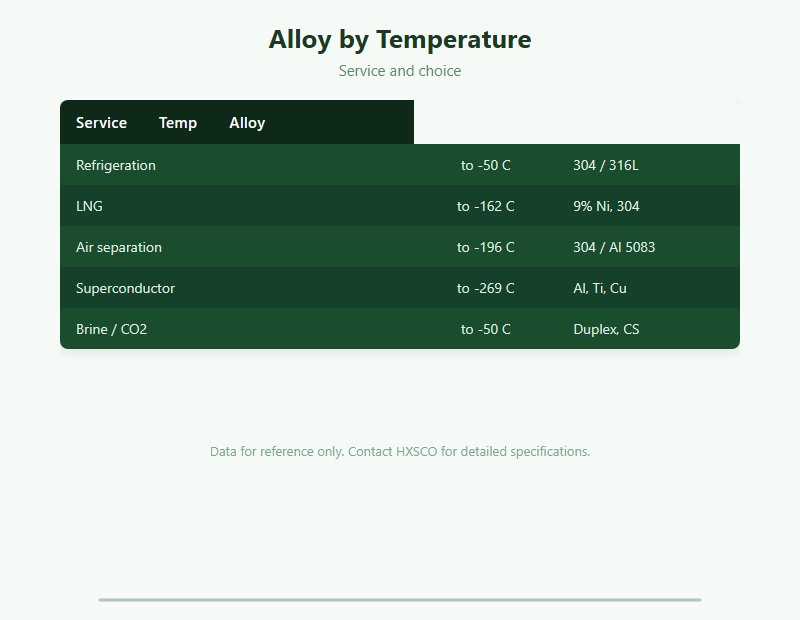
Short answer: Cryogenic metal is chosen for toughness at temperature, not just strength: 304 and 316L stainless for most cold duty, 9 percent nickel steel and aluminum 5083 for LNG and air separation, and titanium or copper where extreme cold and conductivity meet.
At a Glance
Toughness Beats Strength
Below room temperature many steels lose impact toughness, so the design point is the ductile-to-brittle transition, explained in our Сравнение прочности и Fatigue and Endurance Limit guide; the base grades are in our Stainless Steel Supplier range.
LNG, Air Separation and Storage
LNG at minus 162 C uses 9 percent nickel steel and 304, air separation at minus 196 C uses 304 and aluminum 5083, and the chloride care is in our Corrosion Resistance Guide; plate forms are in our 304 Plate и 316 Plate pages.
Extreme Cold and Conductivity
Superconductor and research systems pair aluminum, titanium and copper for cold plus conduction, with titanium in our Titanium Grades Guide and nickel alloys in our Nickel Alloy Supplier; the energy context is our Power Generation Guide и Oil and Gas Guide.
Specifying and Verifying
Buyers set the lowest service temperature and impact test, then confirm with our Mill Test Certificate Guide и Quality Inspection Guide, packed per our Export Packing Guide.
Get a Quote
Tell HXSCO your requirements and we will respond with a competitive quote and lead time.
Часто задаваемые вопросы
304 and 316L keep good toughness down to liquid-nitrogen temperatures.
9 percent nickel steel and 304 stainless for tanks and piping.
Yes, aluminum 5083 is widely used in air-separation and LNG service.
A brittle fracture at low temperature is catastrophic, so impact toughness rules alloy choice.
Only for mild refrigeration; it gets brittle below about minus 45 C.
Specify Cryogenic Metal with HXSCO
HXSCO supplies 304/316L, 9 percent nickel steel, aluminum and titanium for cryogenic duty with low-temperature impact testing. Send your service temperature for a quote.