


Short answer: Quenching media control how fast a hot steel part cools to lock in hardness — water and brine cool fastest (highest distortion and cracking risk), oil and polymer are gentler, and salt/marquench baths give the most uniform, low-distortion result; the choice follows the steel grade and section.
At a Glance
What Quenching Does
Quenching freezes a heated, austenitic structure into martensite for hardness. It is the cooling half of heat treatment — the heating half and tempering follow in Stress Relieving Vs Annealing и Nitriding Vs Carburizing; surface prep is in Metal Surface Treatment Guide.
Media Compared
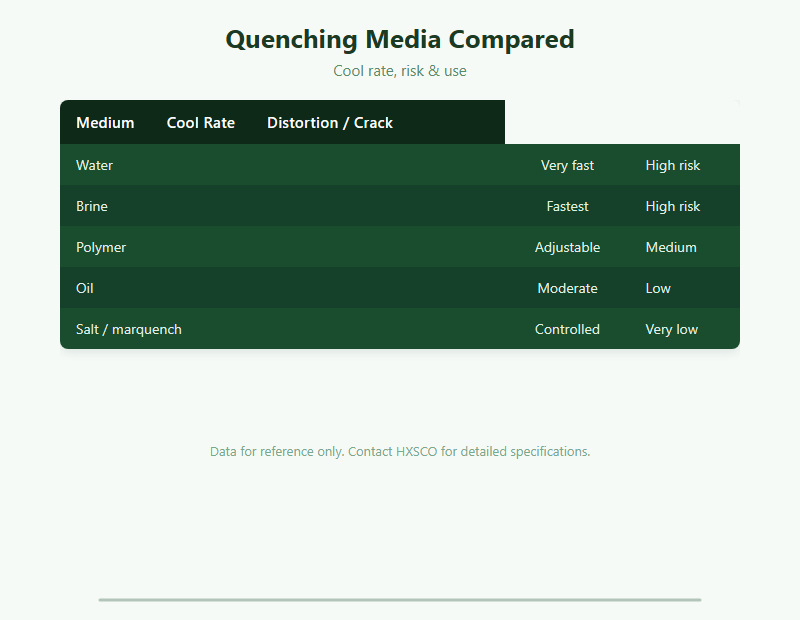
Water and brine quench fastest and risk cracking on复杂 or thick sections; oil is slower and far kinder to the part; polymer (PAG) solutions are tuned between the two; molten-salt and marquench baths give the most uniform, low-distortion cooling for precision Alloy Steel Supplier и Carbon Steel Supplier parts. Fatigue behaviour relates to Metal Fatigue Endurance Limit.
Selection & Safety
Match the medium to the steel’s hardenability and the section’s sensitivity: shallow-hardening carbon steels need fast water; deep-hardening alloy steels do better in oil or polymer. Verify properties from the certificate in Mill Test Certificate Guide; corrosion planning in Galvanic Corrosion Guide.
Get a Quote
Tell HXSCO your requirements and we will respond with a competitive quote and lead time.
Часто задаваемые вопросы
Water quenching cools much faster and gives higher hardness but a high risk of distortion and cracking; oil quenches more slowly and gently, reducing distortion for alloy steels.
Polymer (usually PAG) quenching uses a water-polymer solution whose cooling rate is adjusted between water and oil, balancing hardness and distortion.
Marquench cools the part to a hot salt or oil bath just above martensite start, holds, then air-cools — giving very uniform, low-distortion hardening.
Yes. HXSCO supplies quenching-and-tempering grades (1045, 4140, 4340 and more) with mill certificates and heat-treatment guidance.
Quench & Source Steel with HXSCO
HXSCO supplies heat-treatable carbon and alloy steel for quenching and tempering, with mill certificates. Send your grade, section and hardness for a quote.