


Short answer: Strain hardening raises a metal’s strength and hardness as it is plastically deformed, because dislocations multiply and tangle; it is strongest in pure and austenitic metals and is exploited in cold drawing, rolling and forming — but it also reduces ductility until annealed away.
At a Glance
Why Deformation Strengthens
Below the yield point a metal springs back; past it, dislocations move and multiply, and their tangles obstruct further motion, so more stress is needed for more strain. That is the rising stress-strain curve after yielding. The effect is strongest where few other barriers exist, which is why pure metals and austenitic grades harden most. It also degrades machinability, as Metal Machinability Guide notes, and is locked in or removed by Cold Rolling Vs Hot Rolling и Annealing Vs Normalizing per Metal Heat Treatment Guide.
Alloy Sensitivity
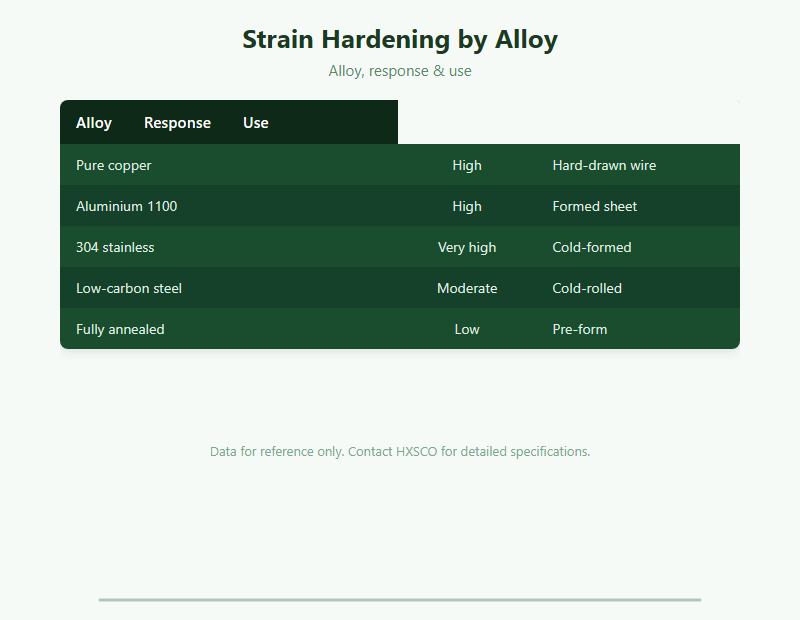
Pure copper and aluminium 1100 harden readily and are sold as hard-drawn tempers; Low Carbon Vs High Carbon Steel hardens moderately and is stocked cold-rolled; austenitic 304 Vs 201 Stainless Steel и Ferritic Vs Austenitic Stainless harden dramatically, which is why 304 grabs the tool if you dwell — see Градации нержавеющей стали с пояснениями. Brasses and bronzes follow the same logic per Copper Alloys Guide.
Design Trade-offs
Exploit strain hardening for strength without alloying, but remember it costs ductility and can raise Yield Strength Vs Tensile Strength margin while lowering formability. A cold-formed spring gains life per Metal Spring Design Guide; a cold-formed part loses fatigue reserve per Metal Fatigue Endurance Limit; and a hardened surface is harder to cut, which matters for How To Cut Stainless Steel.
Get a Quote
Tell HXSCO your requirements and we will respond with a competitive quote and lead time.
Часто задаваемые вопросы
Strain (or work) hardening is the increase in strength and hardness a metal gains as it is plastically deformed, caused by the multiplication and tangling of dislocations.
Pure metals and austenitic stainless (e.g. 304) strain harden strongly; fully annealed low-carbon steel hardens only moderately. Hardening is weak in materials with many pre-existing barriers.
Both: it strengthens formed parts (wire, sheet, springs) without alloying, but it reduces ductility and makes further forming or machining harder.
Annealing reheats the metal so dislocations rearrange and recrystallise, restoring ductility — the process opposite to cold working, covered in annealing-vs-normalizing.
Austenitic stainless work-hardens so fast that a dwelling cutter glazes the surface harder; use sharp tools, rigid setup and steady feed, as in how-to-cut-stainless-steel.
Source Temper-Controlled Metal from HXSCO
HXSCO supplies annealed and cold-worked tempers of copper, aluminium, steel and stainless with hardness and mill certificates. Send your temper and quantity for a quote.