


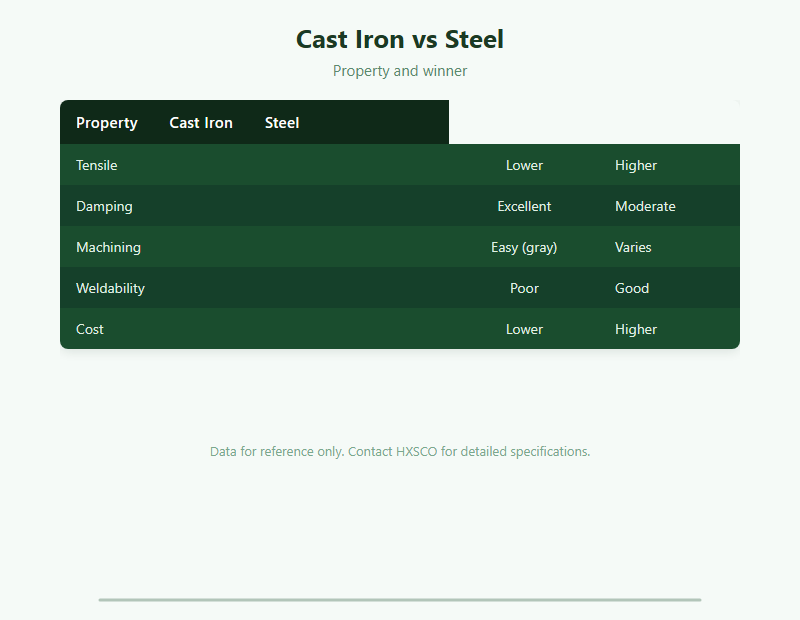
Short answer: Cast iron beats steel on damping, machinability and cost, while steel beats cast iron on tensile strength, weldability and toughness, so engineers pick cast iron for vibration and static load and steel where strength, impact and joining matter.
At a Glance
Composition and Types
Cast iron has more carbon and silicon than steel, with gray, ductile and white grades; the steel families are in our Виды углеродистой стали и Types and Grades of Steel, the strength data in our Сравнение прочности and corrosion care in our Corrosion Resistance Guide.
Strength and Damping
Steel carries higher tensile load, cast iron absorbs vibration; the fatigue angle is in our Fatigue Guide, the construction use in our Construction Structural Guide and weather life in our Weathering Steel Guide.
Machining and Welding
Gray iron machines easily but welds poorly, steel is the reverse; the tooling grades are in our Tool Steel Types Guide, joining in our Welding Joining Guide and the heat treatment in our Heat Treatment Guide.
Cost and Selection
Cast iron is cheaper for complex static parts, steel for loaded ones; the stock is in our Carbon Steel Supplier, the proof in our Mill Test Certificate Guide and packing in our Export Packing Guide.
Get a Quote
Tell HXSCO your requirements and we will respond with a competitive quote and lead time.
Часто задаваемые вопросы
Steel — higher tensile strength and toughness than cast iron.
It damps vibration, machines easily and costs less for complex shapes.
It is difficult; special rods and preheat are needed.
Cast iron — its damping keeps the structure stable.
Steel — for strength, impact and weldability.
Choose Iron or Steel with HXSCO
HXSCO supplies carbon steel, stainless and special grades for parts where cast iron would fall short. Send the duty and we will recommend a grade and quote.