


Short answer: Aluminum pipe and tube are available in seamless and welded forms across 3xxx, 5xxx, 6xxx, and 7xxx alloy series. Pipe is dimensioned by nominal bore (NPS/SCH); tube by exact OD × wall thickness. Common applications include HVAC, automotive, aerospace, marine, and industrial fluid systems.
At a Glance
Pipe vs Tube: Understanding the Difference
While often used interchangeably, there are important distinctions:
| Pipe | Трубка | |
|---|---|---|
| Dimensioning | Nominal bore (NPS) + Schedule | Exact OD × wall thickness |
| Толерантность | Looser (inside diameter focus) | Tighter (OD + ID controlled) |
| Primary use | Fluid/gas transport | Structural, precision, heat exchange |
| Стандарты | ASME B36.10M | ASTM B210, B241 |
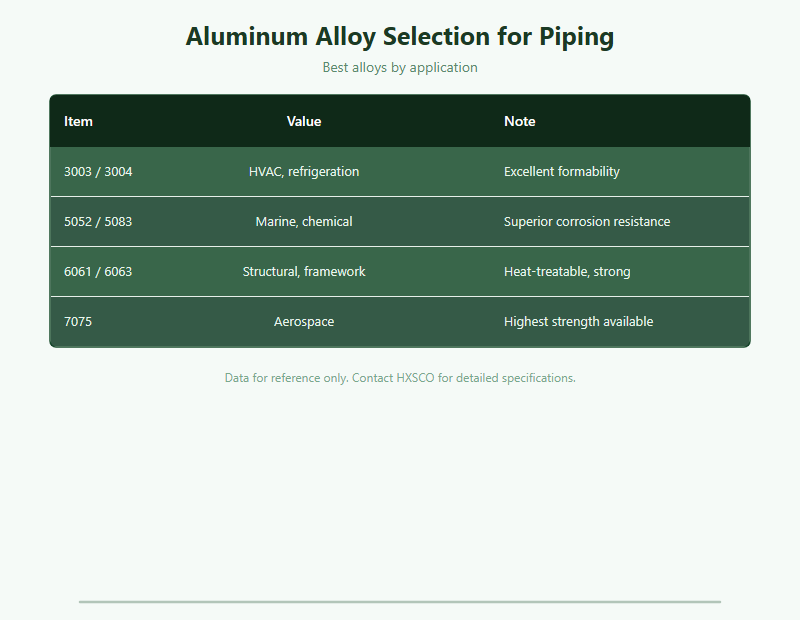
Alloy Selection for Piping Applications
| Сплав | Best For | Notes |
|---|---|---|
| 3003 / 3004 | HVAC, refrigeration, cryogenic | Excellent formability, good brazeability |
| 5052 / 5083 | Marine, chemical process | Superior corrosion resistance. See 5052 vs 6061 |
| 6061 / 6063 | Structural, framework, handrails | Heat-treatable, strong, weldable |
| 7075 | Aerospace, high-strength | Highest strength, lower corrosion resistance |
Manufacturing Methods
Seamless (extruded): Billet heated and extruded through a die. Uniform wall, no weld seam, highest pressure rating. Used for critical applications. Seamless vs welded comparison.
Welded (drawn): Flat strip formed and welded (GTAW/Laser), then drawn down to final size. More economical for large diameters and thin walls. Weld bead can be flush-ground or left as-is depending on requirements.
Drawn: Seamless or welded tube pulled through a die to reduce diameter, improve surface finish, and tighten tolerances. Common for precision hydraulic and instrumentation tubing.
Size Range & Specifications
HXSCO supplies aluminum pipe and tube covering:
- Pipe: NPS 1/8 to 24 inch (DN 6-600), SCH 5-XXS, lengths up to 6 m
- Tube: OD 3 mm – 500 mm, wall 0.5 mm – 20 mm, lengths up to 6 m
- Стандарты: ASTM B210 (drawn), B241 (seamless), B234 (condenser), B345 (pipeline), EN 754/755, DIN 1746/1747
Get a Quote
Tell HXSCO your requirements and we will respond with a competitive quote and lead time.
Часто задаваемые вопросы
Pressure rating depends on alloy, temper, OD, wall thickness, and temperature. As a rough guide, 6061-T6 SCH 40 pipe at ambient temperature handles ~900 psi (NPS 1 inch) to ~140 psi (NPS 8 inch). Always calculate per ASME B31.3 for your specific conditions.
Yes, but aluminum threads are softer than steel and more prone to damage. Use NPT threads only for low-pressure applications. For higher pressures, prefer flare fittings, compression fittings, or butt-weld connections.
Aluminum is excellent for compressed air — lightweight, corrosion-free (no rust in air lines), and smooth interior (low pressure drop). 6061-T1 is the industry standard for compressed air piping systems.
Most aluminum alloys lose significant strength above 150°C (300°F). 3003 series can operate up to ~200°C for low-stress applications. Do not use aluminum for high-temperature steam or hot oil service — use carbon or stainless steel instead.
Options include TIG/MIG welding (most common for permanent joints), brazing (3003 series), mechanical fittings (compression, flare, VCR), and adhesive bonding (low-pressure only). Avoid galvanic contact with steel fasteners without isolation.
Source Aluminum Pipe & Tube from HXSCO
Whether you need seamless or welded, thin-wall precision or heavy-wall structural, HXSCO stocks aluminum pipe and tube in 3003, 5052, 5083, 6061, 6063, and 7075. Send us your spec for a quote.