


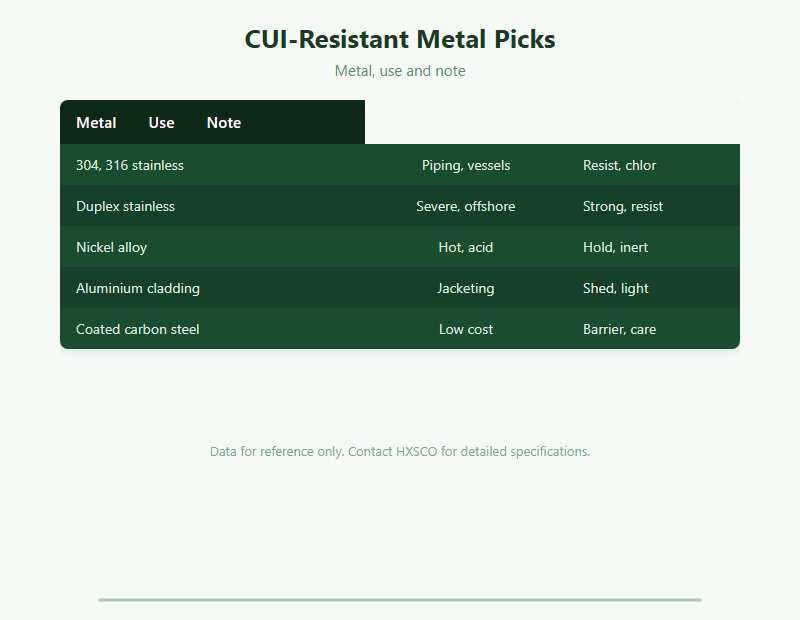
Short answer: Corrosion under insulation is fought with metals that resist chloride and moisture attack – 304 and 316 stainless for general piping, duplex stainless for severe offshore duty, nickel alloy for hot acid service and aluminium jacketing to shed water – plus proper coating and inspection, all chosen to keep hidden surfaces sound between turnarounds.
At a Glance
What CUI Is
Trapped moisture under lagging drives hidden attack, so resistance and barriers lead the choice, with the basis in our Corrosion Protection Guide 그리고 Corrosion Resistance Guide; galvanic risk is in our Bimetallic Corrosion Guide.
Metal Choices
Stainless and duplex resist chlorides, with the stainless basis in our Stainless Steel Supplier and duplex in our Duplex Stainless Steel Supplier; nickel options are in our Nickel Alloy Grades Guide and the trade-off in our Galvanized vs Stainless Steel.
Coating and Cladding
Coatings and aluminium jacketing keep water out, with finish methods in our Surface Treatment Guide 그리고 Finishing Coating Guide; passivation is in our Passivation Guide.
Detection and Sourcing
CUI is found by inspection between runs, with methods in our Non-Destructive Testing Guide 그리고 Quality Inspection Guide; buyers confirm grade via our Mill Test Certificate Guide.
Get a Quote
Tell HXSCO your requirements and we will respond with a competitive quote and lead time.
자주 묻는 질문
Duplex and high-alloy stainless resist chloride attack under insulation.
Yes – aluminium jacketing sheds water and limits moisture ingress.
Yes for low-risk service with a sound barrier coating and inspection.
Nickel alloy for hot, acidic or severe offshore CUI duty.
Ultrasonic and visual inspection during turnarounds, often with insulation removal.
Specify CUI-Resistant Metal with HXSCO
HXSCO supplies stainless, duplex, nickel alloy and aluminium jacketing stock for CUI-prone piping and vessels. Send service conditions for a quote.